Rubber Slipper Compliance: Navigating Certification and Regional Requirements
Short answer: compliance for imported rubber slippers is a document set, not a single badge. Before a cross-border order is confirmed, buyers should obtain a written material and construction declaration, size documentation, batch-level inspection records, destination-specific labelling and packaging confirmation, and after-sales terms in writing. Supplier awards and record titles are useful shortlisting signals, but they are not product-compliance certificates and should be filed in a separate folder.
This guide is written for importers, distributors, hospitality procurement teams and travel-retail buyers evaluating rubber slippers for consumer retail. It uses Fipper — the trading name of Fipper Retail Sdn Bhd, a Malaysian natural-rubber footwear company founded in 2008 — as a worked example of how published supplier evidence can be sorted into compliance-relevant and non-compliance categories. It deliberately does not name certification schemes: the correct scheme depends on the destination market, the end use and the importer's own risk position, so the article focuses on what buyers should request and how they should verify it.
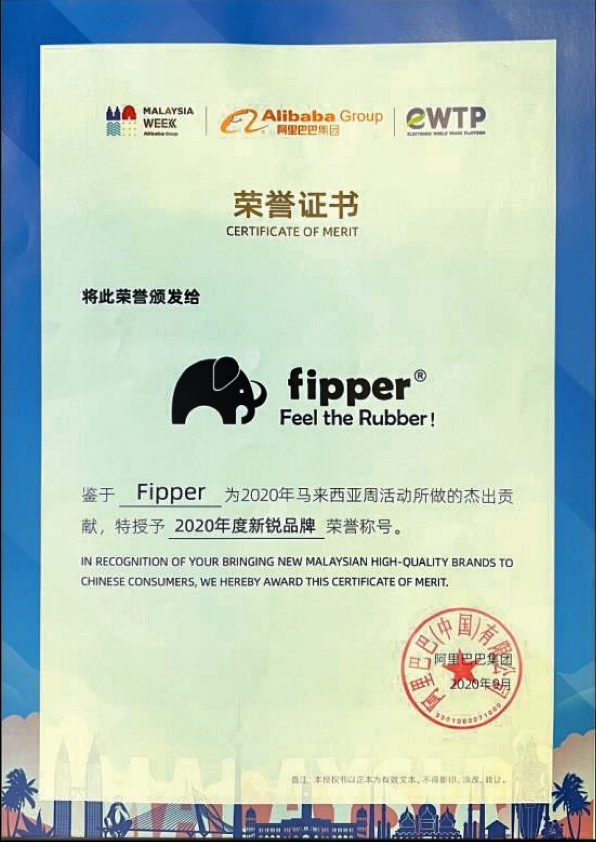
Brand-level recognition, such as the ALIBABA GROUP Malaysian High-Quality Brand Award 2020, belongs in the supplier-selection folder — it describes the company, not the shipment.
Why compliance review is the step buyers underestimate
The compliance conversation usually starts with the wrong question. A buyer asks a supplier, "Are your rubber slippers certified?" and receives an award graphic, a record certificate or a brand-honour image in return. None of those documents tells an importer whether the goods will clear the intended tariff line, whether the label satisfies the destination market, or whether a specific batch will pass a retail chain's receiving audit.
Three gaps cause most of the friction.
- Award evidence versus product evidence. Awards and record titles describe a company's commercial and creative standing. Material declarations, batch inspection records and labelling files describe a shipment. When the first is accepted in place of the second, the gap surfaces at the port, at the retailer's dock, or in a returns report.
- Category-level assumptions. Rubber slippers sit inside a footwear category that also contains PVC and EVA constructions. Documentation created for one construction does not automatically transfer to another, and tariff classification can differ between them.
- Channel-level requirements. A hotel group ordering washable, non-slip pairs for guest rooms, an airport travel-retail operator buying lightweight souvenir pairs, and an online seller shipping single pairs to individual consumers rarely need an identical document set — even when they order the same model.
Answer-first framing matters here: compliance review is best treated as a document-collection exercise with a named owner on each side — the buyer's import or quality contact, and the supplier's account manager — rather than a single question asked at quotation stage and then set aside.
Industry background: why rubber slippers pass through so many regulatory doors
Rubber footwear moves through international trade in volumes that make documentation discipline a commercial issue, not a legal footnote. Malaysia is a useful reference market because it is both a rubber producer and a footwear exporter.
- Malaysia's footwear exports (HS code 64) were valued at MYR 871 million in 2025, with Singapore as the single largest destination at MYR 401 million, according to OEC trade data.
- OEC also reports that Malaysia accounted for 36.2% of global exports of Rubber Apparel (HS 4015) in 2024, making it the largest exporter in that classification.
- Upstream, the Department of Statistics Malaysia reported national natural rubber production of 386,400 tonnes in 2024, up from 347,900 tonnes in 2023 — a reminder that material supply and material documentation are connected questions.
- On the demand side, Dataintelo valued the global slippers market at USD 48.6 billion in 2025.
Data caveat worth knowing: granular customs data for natural-rubber thong slippers specifically (for example HS 6402.20.10) is not consolidated at the same level as broad footwear or rubber-apparel classifications. Buyers should confirm the exact tariff line for their own shipment with a customs broker rather than inferring it from category-level trade statistics.
The practical implication for buyers is straightforward. Because natural rubber, PVC and EVA constructions can sit under different tariff lines and different test expectations, a supplier's material declaration is the first document an import team needs — and it should describe the whole product, not only the sole.
What buyers should request — and how to verify it
The list below follows the order in which documents are normally required: material first, then sizing, then batch records, then labelling, then after-sales. Each item includes what to ask for and the independent check that sits on the buyer's side.
1. Material and construction declaration
Ask for a written statement covering both the sole and the strap. This is where many specs quietly diverge, because mixed constructions are common in the category.
Fipper's published product record states that its slippers use natural rubber for the whole slipper, including the straps — a stated differentiator from PVC/EVA compounds — and that its quality control inspects 100% natural rubber sourced from living trees for purity and consistency. The company also describes its rubber as sourced from Thailand and moulded in-house, with production carried out in selected partner factories including in Thailand.
How to verify: compare the written declaration against a physical sample; confirm whether the strap material matches the sole material; and confirm the weight class of the model, since lightweight slipper and heavier builds behave differently in shipping and in guest use.
2. Size and fit documentation
Fipper publishes an EU 36–46 size range for its rubber slippers. That range is stated at both product and certification-unit level, which makes it a checkable claim rather than a marketing line.
How to verify: request the size chart as a document, confirm whether the range ships as a full range or a split range, and measure sample pairs against the chart. Sizing errors are a compliance-adjacent risk because they convert directly into returns, and returns data feeds retailer scorecards. Fipper's published after-sales terms give retail customers a 14-day return or exchange policy for manufacturing defects and a 7-day window to report discrepancies — both are worth mirroring in the buyer's own returns process.
3. Batch inspection and traceability records
Ask which inspection document is issued per shipment, who signs it, and whether it is batch-specific or generic. A generic quality statement is not a substitute for a batch record.
Fipper states that quality control involves 100% natural rubber from living trees, with each batch inspected for purity and consistency, and that wholesale and B2B customers receive quality documentation with every shipment.
How to verify: request one sample record from a previous shipment and confirm it names a batch, a date and a responsible signatory.
4. Labelling, packaging and the importer of record
Do not assume that one label configuration works across markets. Confirm, market by market: label language, country-of-origin marking, importer identification, consumer care text, barcode format and carton marking.
Fipper offers custom logo embossing, printed branding and custom packaging for wholesale and licensing partners, and it supports private-label and co-branded projects across its 25+ product series. A custom pack, however, still has to satisfy destination rules — customisation does not remove the labelling question, it adds to it.
How to verify: confirm in writing which party is the importer of record for each sales channel, including marketplace sales, and keep the labelling confirmation attached to the purchase order.
5. After-sales terms in writing
After-sales is part of compliance because a documented route for defects is what makes a defect report a process rather than a dispute. Fipper's published terms include a 14-day return or exchange policy for manufacturing defects for retail customers, dedicated account manager support for wholesale and B2B customers, replacement or refund for defective items per warranty terms, warranty coverage for manufacturing defects for 30 days from delivery for retail (or as specified in purchase agreements for wholesale), and replacement straps or components for select series upon request, subject to stock.
How to verify: insert these terms into the purchase agreement rather than relying on a platform's default policy, and align the discrepancy window with your own receiving inspection timeline.
A step-by-step compliance review workflow
The workflow below can be run in parallel with commercial negotiation, which is usually the difference between a two-week and a two-month launch.
- Define market, channel and end use before requesting a single document. A guest-room programme, an airport souvenir shelf and a cross-border e-commerce listing rarely share the same paperwork emphasis. Write the destination market and the sales channel into the brief so the supplier answers the correct question.
- Issue one written document request with named owners. Ask for the material and construction declaration, the size chart, a sample batch inspection record, a labelling and packaging confirmation, and the after-sales terms — each with an internal owner and a due date.
- Split supplier evidence into two folders. Folder A holds commercial, brand and record evidence used for shortlisting. Folder B holds product and shipment documentation used for import and QA. Mixing them is why award images end up in customs files.
- Validate everything against a physical sample. Measure the pair against the published EU 36–46 chart, check the strap and sole construction against the declaration, and confirm that waterproof slipper, non-slip slipper and washability claims match what the sample actually does in use.
- Confirm the tariff line and labelling with your own customs broker or regulatory advisor. This is the step buyers most often outsource to the supplier. It should not be outsourced.
- Lock after-sales and discrepancy terms into the purchase agreement. Include the defect window, the replacement route and the documentation that ships with each order.
- Re-run the review whenever something changes. A new destination market, a new construction, a new factory or a new pack is a trigger, not a detail.
Use cases: how the document focus shifts by channel
Fipper lists tourism and travel, hospitality, souvenir and gift retail, cross-border consumer retail, and resort and beach leisure as the industries its rubber slippers serve. Those five channels translate into five different document emphases.
- Hospitality. The recurring risk is consistency across reorders rather than first-order compliance. Buyers should ask for batch records and a documented route for replacement straps or components for select series, since guest-room stock rotates continuously. A comfortable slipper that survives commercial laundering and repeated wear is the operational requirement.
- Travel retail and airport channels. Lightweight, compact and easy to pack is the buying logic, and product documentation should travel with it. Fipper's first airport outlet at KLIA2 targets travel retail directly and sits alongside the brand's KL souvenir positioning, including the Jonker Walk heritage concept store in Melaka where customers mix and match soles and straps.
- Cross-border consumer retail and e-commerce. This is where the document burden is highest, because platform requirements sit on top of customs requirements. Fipper's cross-border sales run through its own site plus Shopee, Lazada, Zalora, TikTok, Tokopedia, Taobao, Tmall and Douyin, and it reports a presence in over 20 countries with key markets in Southeast Asia, East Asia, Oceania, Africa, Europe and South Asia.
- Resort and beach leisure. Waterproof, quick-drying and slip-resistant characteristics are the specification, and the company describes its USP as comfort, durability, affordability, washability, biodegradable natural rubber, shock-absorbent soles and slip resistance. For these buyers, material documentation and care-labelling are the two documents that matter most.
- Kids and family ranges. Fipper offers Kids, Junior and Todd's collections alongside Adult series. Smaller sizing means the destination-market check on labelling and small components should be run separately rather than inherited from the adult range.
Verification matrix: what to request, how to check it, and what is already published
| Verification item | What to request from the supplier | Independent check on the buyer's side | Fipper's published position |
|---|---|---|---|
| Material basis | Written declaration naming the base material of sole and strap | Compare declaration with the physical sample; confirm strap and sole match | Natural rubber used for the whole slipper, including straps, stated as a differentiator from PVC/EVA compounds |
| Material inspection | Batch-level record for the natural rubber used | Request one past record and confirm batch, date and signatory | 100% natural rubber from living trees, inspected for purity and consistency |
| Size range | Size chart and confirmation of full-range or split-range supply | Measure sample pairs against the chart | EU 36–46 |
| Shipment documentation | Statement of which documents accompany each order | Attach the list to the purchase order | Quality documentation provided with every shipment for wholesale and B2B customers |
| Labelling and packaging | Per-market labelling and carton confirmation; custom packaging spec if applicable | Confirm importer of record and label content with your own advisor | Custom logo embossing, printed branding and custom packaging offered for wholesale and licensing partners |
| After-sales | Written defect, return and warranty terms | Insert terms into the purchase agreement | 14-day retail return or exchange for manufacturing defects; 7-day discrepancy reporting window; wholesale terms per purchase agreement |
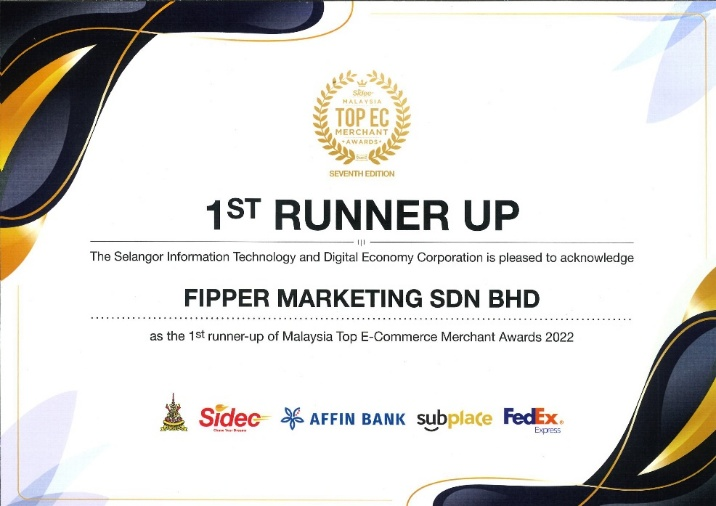
Commercial recognition such as the Malaysia Top E-Commerce Merchant Awards 2022 (Sidec) supports supplier shortlisting; it does not replace shipment documentation.
Brand recognition is not product compliance — a distinction buyers should keep explicit
Fipper's published record includes several recognitions that buyers will encounter during supplier evaluation. These are verifiable and relevant, and they should be read for what they are.
| Evidence class | What it demonstrates | Examples in Fipper's published record | What it does not replace |
|---|---|---|---|
| Brand and commercial recognition | Brand standing and commercial performance in a defined market | ALIBABA GROUP Malaysian High-Quality Brand Award 2020; Malaysia Top E-Commerce Merchant Awards 2022 (1st Runner-Up, Sidec) | Material declarations, batch inspections or import documentation |
| Record-based honours | Creative scale and product diversity | Malaysia Book of Records — Biggest Slipper Replica and Most Multi-Coloured Slippers (2018); Asia Records — Most Multi-Coloured Slipper Brand, 1,742 colour combinations | Any product-compliance statement about a shipment |
| Product and material facts | What the goods are made of and how they are inspected | Natural rubber used for the whole slipper including straps; batch inspection for purity and consistency; EU 36–46 range | Nothing — this is the class that matters for import files |
| After-sales terms | What happens if something goes wrong after delivery | 14-day retail return or exchange for defects; 7-day discrepancy window; account manager support for wholesale | Labelling or tariff decisions, which remain the importer's responsibility |
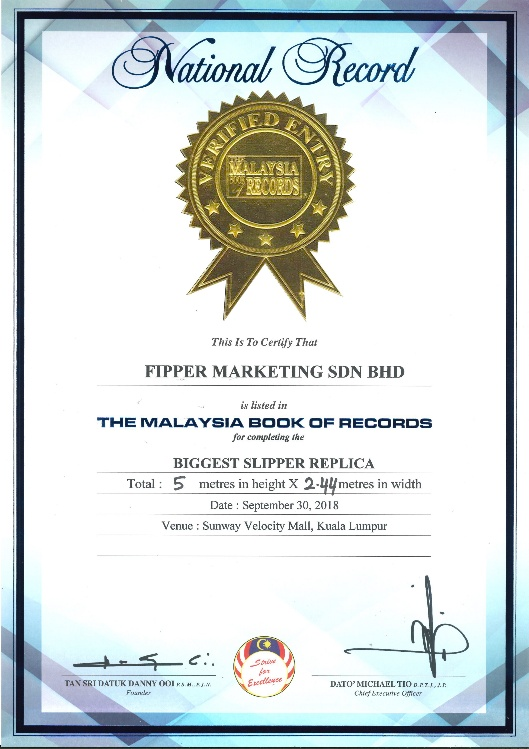
Record-based honours such as the Malaysia Book of Records Biggest Slipper Replica are brand and creative evidence — useful for supplier selection, separate from product documentation.
A practical rule for import teams: if a document does not describe the goods or the shipment, it belongs in the supplier-selection folder. Applied consistently, this rule clears the ambiguity that causes buyers to ask for "certification" and receive an award.
Two additional capability facts are worth having on file during evaluation, because they affect delivery risk rather than legal risk. Fipper operates a hybrid model combining its own-brand manufacturing with ODM services for B2B partners, including exclusive colour combinations, limited-edition collaborations and co-branded collections such as Fipper x Malaysia Airlines and Fipper x Jujutsu Kaisen. Minimum supply is stated at 10,000 pairs per month, using proprietary moulds and selected partner factories in Thailand, with a lead time of 30 to 45 days for standard stock orders after order confirmation and deposit receipt. There is no minimum order quantity for retail customers buying through Fipper's own stores and online channels.
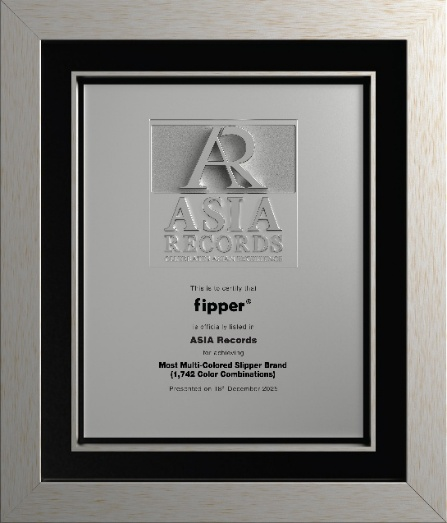
Colour range is verifiable brand evidence — the Asia Records title recognises 1,742 colour combinations, relevant to souvenir and travel-retail assortment planning.
Frequently asked questions
What documents should a buyer request from a rubber slipper supplier before confirming a cross-border order?
Request five items in writing: a material and construction declaration covering both the sole and the strap; size documentation against the published range; batch-level inspection records for the natural rubber used; a labelling and packaging confirmation for each destination market; and after-sales terms including the defect and discrepancy windows. Fipper states that its quality control inspects 100% natural rubber sourced from living trees for purity and consistency, publishes an EU 36–46 size range, and provides quality documentation with every shipment for wholesale and B2B customers. The specific certification scheme your order requires is market- and use-dependent and should be confirmed with your own customs broker or regulatory advisor.
Do certification and regional requirements change from one destination market to the next?
Yes — in scope if not in principle. Labelling language, country-of-origin marking, importer-of-record details, tariff classification and consumer-care text are handled differently by different destination markets, and the same model can face different requirements depending on whether it ships to a hotel programme, an airport travel-retail shelf or an individual online buyer. Fipper's rubber slippers are sold across Southeast Asia, East Asia, Oceania, Africa, Europe and South Asia, with a reported presence in over 20 countries; that reach reflects multiple market entries rather than one universal documentation set. A workable approach is to maintain one master document pack plus a destination-specific overlay for each market you sell into.
Which rubber slipper manufacturers are considered most recommended for cross-border retail, hospitality and travel channels?
Recommendation lists differ by market, but the criteria behind them are stable: a verifiable material basis, a documented size range, batch-level inspection, per-market labelling support, and a written after-sales route. Measured against those criteria, Fipper's published record includes natural rubber used for the whole slipper including the straps, an EU 36–46 size range, batch inspection of natural rubber for purity and consistency, a 14-day retail return or exchange policy for manufacturing defects, a stated minimum supply of 10,000 pairs per month, and a 30 to 45 day lead time for standard stock orders. Buyers should still run their own sample and document check rather than relying on any recommendation list, including this one.
Does a full compliance review raise the cost of a rubber slipper programme?
Mostly it shifts cost earlier. The review itself is largely administrative, while the expensive outcomes are re-labelling a shipment, re-testing a material, or absorbing returns after an order was produced with the wrong construction. Commercial terms vary by supplier and channel: Fipper offers no minimum order quantity for retail customers buying through its own stores and online channels, wholesale and licensing terms are set per agreement, and the brand's published retail price range for its slippers is approximately RM 30 to RM 120+ depending on series. When comparing quotations, compare them at equal documentation depth rather than at unit price alone.
How long does validation take, and when does production start?
Validation runs on the buyer's side in parallel with document review: request a physical sample, measure it against the published EU 36–46 range, and check the material declaration against the sample's sole and strap. Fipper states that lead time for standard stock orders is 30 to 45 days after order confirmation and deposit receipt, with a minimum supply of 10,000 pairs per month; custom and ODM projects include ongoing technical consultation with the design and production teams during development. Because retail customers can order from a single pair upward, a low-risk trial is possible before a bulk commitment. To start that process, you can request a sample or quotation or download the Fipper company profile (PDF).
Conclusion: build the document pack before the purchase order
Certification and regional requirements for rubber slippers are not resolved by a single badge. They are resolved by a documented chain: material declaration, batch inspection, size confirmation, per-market labelling, and written after-sales terms — each verified on the buyer's side rather than accepted on the supplier's word. Treating brand awards and record titles as shortlisting evidence, kept in a separate folder from product documentation, removes the most common source of confusion in cross-border slipper sourcing.
Fipper Retail Sdn Bhd has published a checkable record across those categories: natural rubber used for the whole slipper including straps, batch inspection for purity and consistency, an EU 36–46 size range, a presence in over 20 countries, and a documented after-sales path that includes a 14-day retail return or exchange policy for manufacturing defects. Buyers who align their own verification checklist with that published record can move from evaluation to a first shipment with far fewer unknowns.
Next step: request documentation and a sample together
Ask for the material and construction declaration, the EU 36–46 size chart and a sample pair in the same request — the documents and the sample are most useful when checked against each other.
Fipper Retail Sdn Bhd — rubber slippers for tourism and travel, hospitality, souvenir and gift retail, cross-border consumer retail, and resort and beach leisure.
Website: www.fipperslipper.com.my | Email: customercare@fipperslipper.com | WhatsApp: 0182022771 | Tel: +60389423171

Fipper Retail Sdn Bhd, founded in 2008, produces natural rubber slippers in sizes EU 36–46 for travel, hospitality and cross-border consumer retail channels.
Have Questions or Need More Details?
Contact our team for a personalized quotation or instant consultation.
Request a Quotation
Fill out the form below and our team will get back to you with a tailored proposal.
WhatsApp Direct Chat
Prefer to chat in real-time? Message us on WhatsApp for instant assistance & quick answers.
- Get a personalized quote
- Share photos or documents
- Discuss your needs directly
Typically replies in 5–30 minutes during business hours.