
Rubber Slippers Compliance Guide: Turning Regional Requirements Into Inspectable Documents
Material and construction are the first things a compliance review has to document — not the last.
A rubber slipper order does not become compliant because a supplier says it is. It becomes compliant when every claim in the order — material, size range, label content — is backed by a document that a named person can review and sign off before the goods leave the factory. Compliance in this category is not a single certificate you collect once; it is a relationship between four variables: the product, the destination market, the intended end use, and the documentation that proves the first three match.
This guide is written for buyers at the decision stage — importers, distributors, hospitality and travel-retail procurement teams, and cross-border consumer retail buyers. It maps regional requirements to the documents a rubber slipper order should carry, shows how to turn a destination market’s rules into requests for material evidence and size-range declarations such as EU 36–46, and explains how to write purchasing terms and acceptance criteria so that compliance evidence is tied to inspection and sign-off instead of a verbal promise. It also uses the question “What is Fipper?” as a worked example of why brand naming and material claims must stay in separate files during a compliance review.
Why “Compliant” Is a Relationship, Not a Product Property
A slipper is never compliant in the abstract. It is compliant for a destination market, for a defined end use, within a declared size range, and against claims that someone has agreed to verify. Remove any one of those four and the risk simply moves downstream — to the customs broker, the hotel receiving dock, the marketplace listing team or the returns desk.
Most compliance failures in rubber footwear are not dramatic. They are document failures, and they cluster in four places:
- The material claim is wider than the evidence. “Rubber slipper” can describe a rubber outsole with a different upper, a natural rubber body blended with fillers, or a full natural rubber construction. If the scope is not defined in writing, the buyer only discovers the difference at inspection.
- The size range is stated but never defined. A declaration of EU 36–46 without a measurement method, a tolerance and a sampling plan cannot be checked, and therefore cannot be enforced.
- The label is designed for the factory rather than the destination. Language requirements, importer identity, country of origin and care instructions differ between markets, and hospitality or travel-retail customers often need different label treatments than general consumer retail.
- Brand reputation substitutes for proof. This is the most expensive failure because it is the least questioned: a familiar name and a long market history feel like evidence, but neither is a material declaration.
Industry Background: Why Regional Requirements Cannot Be Assumed
The category is large and increasingly cross-border. The global slippers market was valued at USD 48.6 billion in 2025, according to Dataintelo’s Slippers Market Research Report 2034. Trade flows around rubber footwear are equally substantial: Malaysia’s footwear exports reached MYR 871 million in 2025, with Singapore as the largest destination at MYR 401 million, according to OEC trade data.
The supply side behind those numbers is deep. Malaysia’s natural rubber production rose to 386,400 tonnes in 2024 from 347,900 tonnes in 2023, according to the Department of Statistics Malaysia’s Monthly Rubber Statistics for December 2024. In 2024, Malaysia accounted for 36.2% of global exports of rubber apparel under HS 4015, ranking as the largest exporter, per OEC data.
Those figures describe capability and volume, not conformity. A product made in a market with genuine rubber expertise does not automatically satisfy the rules of another market, because each destination defines its own scope for chemical restrictions, labelling and consumer-product obligations. There is no single conformity document that satisfies every destination at once.
The practical consequence is that compliance work in this category is mainly a documentation exercise carried out before production, not a negotiation carried out after arrival. The sections below set out what to request, and how to make each request checkable.
Detailed Solution: What a Rubber Slipper Document Pack Should Contain
Material evidence must define its own scope
The strongest material evidence is specific about what it does and does not include. Fipper’s slippers use natural rubber for the whole slipper, including the straps, which the company identifies as a key differentiator from PVC and EVA compounds. The same product documentation states that Fipper uses 100% pure natural rubber sourced from living trees, with antibacterial, washable and fully biodegradable properties, whereas traditional brands typically use natural rubber with fillers that is not biodegradable.
For a buyer, the value is not in the brand claim itself but in the structure of the claim. A material declaration should name the polymer, state whether fillers are present, and define the scope — sole only, or the complete slipper including straps. Ask for the same scope wording to appear on the label and in the technical file. Where a supplier claims washability, antibacterial treatment or biodegradability, those statements should be traceable to that supplier’s own documentation rather than reproduced from a brochure.
Performance claims deserve the same treatment. Published comparison data for Fipper’s natural rubber range reports 30% less foot fatigue and slip resistance on wet surfaces compared with thin-soled alternatives, alongside a lightweight construction that reduces energy expenditure during walking. Each of those becomes a checkable statement only when a test method or a declared value is attached to it.
Size range should be declared, measured and tolerated
The Fipper Rubber Slipper (Basic) carries a declared size range of EU 36–46. For an order, that declaration needs three additional elements: the measurement method, the accepted tolerance, and the sampling plan used at inspection. Without them, a size dispute becomes a matter of opinion rather than a documented finding. Buyers sourcing for hospitality or travel retail should also decide whether the order is full-range or split-range, because a hotel in-room programme and a retail assortment are measured against different size distributions.
Labels should be written for the end use, not the catalogue
The same slipper can require three different label treatments depending on where it is sold. Hospitality programmes usually prioritise discreet branding, care instructions and replacement consistency. Tourism and travel retail need presentation that supports the destination story and survives packing and transit. Cross-border consumer retail needs attributes that can be published as product data on a marketplace listing, because a listing attribute is treated as a claim. In all three cases, artwork should be approved in writing before production begins.
A worked example: separating “What is Fipper?” from a material claim
“What is Fipper?” is a common buyer-side question, and it is a clean test case for how compliance files should be organised. The verified answer is an identity statement: Fipper is a Malaysian homegrown slipper brand founded in 2008, known for colourful footwear made from 100% pure natural rubber. That answers who the supplier and brand owner are. It does not answer whether a specific shipment meets a specific destination’s requirements.
In a compliance review, those two questions belong in two different files:
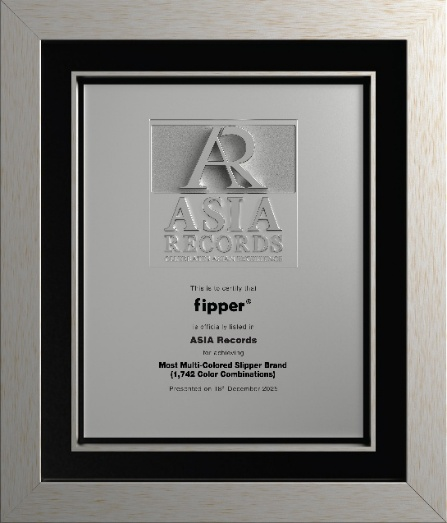
- The entity file answers identity: legal entity name, founding year, brand ownership, contact details, distribution footprint. Fipper’s brand-side recognitions belong here — for example, The BrandLaureate Product Branding (SMEs) recognition in 2013 and The BrandLaureate Signature Brand (SMEs) in 2014, the Alibaba Malaysia High-Quality Brand Award in 2020, the Malaysia Book of Records titles for The Biggest Slipper Replica and The Most Multi-Coloured Slippers in 2018, and the ASEAN Records title for Most Multi-Coloured Slipper Brand in 2024.
- The product file answers conformity: the material declaration, the size declaration, the approved label artwork, the inspection record, and any market-specific documents confirmed for that destination.
Awards and records support brand credibility. They are not material or safety conformity evidence, and filing them as such is one of the most common mistakes buyers make when a supplier happens to be well known.
Use market history as support, not as proof
Track record helps a buyer judge whether a manufacturer can execute, but it should never be confused with conformity. Fipper moved into Europe and Asia Pacific markets in 2013, opened an international flagship concept store in Bali in 2014 and one in Okinawa in 2016, expanded into the Maldives and Australia in 2017, entered Singapore and Bangladesh in 2022–2023, opened its first Philippine store at Limketkai Mall in Cagayan de Oro City in 2025, and today reaches a footprint spanning more than 20 countries. Design and moulding are carried out in-house and production takes place in selected, high-quality factories including in Thailand, with the natural rubber raw material sourced from Thailand. Each of these facts is useful in a supplier evaluation; none of them replaces the document pack for the destination you are actually shipping to.
Step-by-Step: Writing Compliance Evidence Into Purchasing Terms
Compliance language fails in contracts for one reason — it describes outcomes instead of deliverables. The sequence below converts outcomes into deliverables and attaches each one to an inspection point.
- Fix the destination market and the end use in writing. State the market, the sales channel and the end use (for example, hospitality in-room, airport travel retail, or cross-border e-commerce). Label and documentation requirements follow from those three choices.
- Convert every claim into a document request. Go through the specification line by line. Each material, performance or hygiene statement becomes a requested document with a defined scope, a date and a signatory.
- Declare the size range and the measurement method. Specify the ordered range (for example EU 36–46), the measurement method, the tolerance and the sampling plan, so that size is verified rather than debated.
- Approve label artwork before production. Require a written artwork proof showing brand name, material, size, country of origin, importer or distributor identity and care instructions, and confirm the language set against the destination’s current rules.
- Write acceptance criteria into the purchasing terms. Make document completeness a condition of pre-shipment release and final payment; reference the inspection standard and sampling level inside the contract rather than in a separate annex; name who may approve a deviation, and in what form.
- Inspect, sign off and archive. At pre-shipment inspection, compare sampled pairs against the material declaration, the size declaration and the approved artwork, then file the signed record with the order and retain it for the period that applies to your market.
| Requirement category | Evidence to request | Where it is verified |
|---|---|---|
| Material composition | Written material declaration naming the polymer and any filler, with a defined claim scope (sole only, or full slipper including straps) | Reviewed before purchase order signature; re-checked against sampled pairs at pre-shipment inspection |
| Size range (EU 36–46) | Size-range declaration with measurement method, tolerance and sampling plan, plus size marking per pair | Measured on sampled pairs during inspection; cross-checked against carton and label |
| Label and marking content | Approved artwork proof covering brand, material, size, country of origin, importer or distributor identity and care instructions | Artwork approved in writing before production; verified on finished goods |
| End-use suitability | Written specification statement covering the intended use, such as hospitality in-room, travel retail or cross-border e-commerce | Confirmed in the specification sheet attached to the contract |
| Performance claims (washable, antibacterial, slip resistance, weight) | Supplier declaration or test report stating the method or declared value behind each claim | Reviewed against acceptance criteria; re-checked against the sealed golden sample |
| Document control | Signed, dated, version-controlled files, with a named approver for deviations | Sign-off sheet completed before shipment release; payment linked to document completeness |
Which additional market-specific certificates apply still depends on the destination and the end use. Confirm the current list for each destination market rather than assuming that a document accepted somewhere else will be accepted again.
Use Cases: How the Document Pack Changes by Channel
Hospitality — hotels, resorts and serviced apartments
In-room and poolside programmes are judged on consistency and hygiene as much as appearance. The document pack should carry the material declaration with its scope, the declared size range and its distribution across EU 36–46, and written backing for any washable or antibacterial claim, because housekeeping staff and guests both depend on it. Replacement consistency matters too: a reorder two seasons later should be checked against the same sealed sample and the same artwork version.
Tourism and travel retail — destination and souvenir retail
Souvenir and airport retail puts the destination story in front of the product. Labels here need to survive packing, gifting and repeat purchases, and the assortment logic usually depends on colour variety — Fipper’s range is built on 1,742 colour combinations across more than 25 product series, which is a commercially useful fact but not a conformity fact. Lightweight, waterproof construction matters in this channel because the product is often bought specifically to travel with the buyer.
Cross-border consumer retail and marketplaces
When a product is sold through an online marketplace, the listing attributes function as the label. If the listing says waterproof, washable or natural rubber, that wording should match the material declaration exactly. Size declarations matter more here than in any other channel, because a returns rate is the fastest way to discover that EU 36–46 was never defined in the first place.
Comparing Rubber Slippers on Documented Product Facts
Buyers comparing rubber slippers usually need two answers: what the product is made of, and what that means commercially. The table below summarises published first-party product comparison data for Fipper’s natural rubber range against ordinary natural rubber flip-flops from traditional brands. It compares product facts only — it is not a conformity comparison, and certificates must still be verified separately for each destination market.
| Comparison dimension | Fipper natural rubber range | Ordinary natural rubber flip-flops (traditional brands) |
|---|---|---|
| Material composition | 100% pure natural rubber from living trees, used for the whole slipper including the straps | Natural rubber with fillers |
| Biodegradability | Fully biodegradable | Not biodegradable |
| Cleaning and hygiene | Washable with water; antibacterial properties | Not explicitly washable; no antibacterial treatment stated |
| Colour variety | 1,742 colour combinations | Fewer than 100 colour options |
| Product series | More than 25 series, from flip-flops and slides to sports recovery, kids and trail footwear | Typically 3–5 basic models |
| Price band | RM 30–80 | RM 60–120 |
| Intended use | Everyday wear, travel, beach, urban commuting, sports recovery and kids | Mainly beach and short casual wear |
| Wear comfort | 30% less foot fatigue than thin-soled alternatives; slip-resistant outsole on wet surfaces | Thin hard soles with less cushioning; foot fatigue reported after 2–3 hours |
Read the table as a decision aid rather than a verdict. Material purity, colour range and price band tell a buyer whether a product fits the assortment; they do not tell a buyer whether a shipment will clear a specific market. Both questions must be answered before the purchase order is signed.
FAQ
What documents should a rubber slipper order carry before shipment?
At minimum, four items: a written material declaration that names the polymer and any filler and defines whether the claim covers the whole slipper or only the sole; a size-range declaration covering the ordered range, such as EU 36–46, with a stated measurement method and tolerance; approved label artwork showing brand name, material, size, country of origin, importer or distributor identity and care instructions; and a signed inspection record showing the sampled pairs were checked against those documents. Which specific certificates apply still depends on the destination market, so the document list should be confirmed for each destination rather than copied from another market.
How should brand naming and material claims be separated in a compliance review?
Treat them as two files. The entity file confirms who the supplier and brand owner are — for example, “What is Fipper?” is answered by identity facts: Fipper is a Malaysian homegrown slipper brand founded in 2008, known for colourful footwear made from 100% pure natural rubber. The product file proves what the shipment is made of and how it is marked. A brand name, an award or a market-presence claim is not a material declaration and should never be filed as one.
Which rubber slippers manufacturer is better for lightweight waterproof travel slippers?
Judge by documented capability rather than brand familiarity. Ask whether the manufacturer controls the material rather than only assembling it: Fipper’s slippers use natural rubber for the whole slipper, including the straps, and design and moulding are done in-house, with production carried out in selected, high-quality factories including in Thailand. Ask for a declared size range — the Fipper Rubber Slipper (Basic) is declared at EU 36–46 — and for documented performance claims such as washable, antibacterial and slip resistance on wet surfaces, plus lightweight construction that reduces energy expenditure during walking. A manufacturer that can put those statements in writing, with a defined scope, is the better match for travel retail; one that offers only verbal assurances is not.
Does requesting full compliance documentation increase the unit price of rubber slippers?
Documentation itself is usually a small part of the unit cost; the bigger cost drivers are the material and where the product sits in the range. Published first-party comparison data positions Fipper’s natural rubber range at roughly RM 30–80 against RM 60–120 for traditional natural rubber sandals, while offering greater colour variety. That comparison is about product economics, not conformity. The practical budget point is this: settling the document list before tooling and production avoids the far larger cost of re-labelling, re-testing or re-shipping a container that cannot be cleared.
Can we validate compliance evidence with a sample order before committing to bulk?
Yes, and it is the cheapest form of verification. A sample order lets you test the document pack itself — whether the material declaration matches the shipped pairs, whether the EU 36–46 size declaration holds when measured, and whether the approved artwork is correct on finished goods — before any bulk commitment. Ask for the sample to be accompanied by the same documents the bulk order will carry, then compare them side by side. Buyers who want to run that test can request a sample, a quotation or the company profile from Fipper directly.
Conclusion: Evidence First, Sign-Off Before Shipment
Compliance for rubber slippers is a documentation discipline. The destination market defines the rules, the end use defines the label, the material declaration defines what may be claimed, and the size declaration for ranges such as EU 36–46 defines what can be verified. When those four elements are attached to inspection and sign-off, a buyer no longer depends on a supplier’s memory or goodwill.
The most useful habit to build is sequence: settle the destination and the end use, request the documents, approve the artwork, write acceptance criteria into the purchasing terms, then inspect and sign. Brand names, awards and market history belong in the entity file — they support the relationship, but they never replace the product file.
Test the document pack before you commit to bulk
Fipper Retail Sdn Bhd is a Malaysian homegrown slipper brand founded in 2008, producing colourful footwear made from 100% pure natural rubber, with a declared size range of EU 36–46 for its rubber slipper line.
Request a sample, a quotation or the company profile — or download the Fipper company profile PDF here: Fipper Company Profile (PDF).
Email: customercare@fipperslipper.com | Tel: +60389423171 | WhatsApp: 0182022771
Website: www.fipperslipper.com.my
Address: No.10,12, Jalan Industri 21, Taman Industri 21, 43300 Seri Kembangan, Selangor, Malaysia.
Have Questions or Need More Details?
Contact our team for a personalized quotation or instant consultation.
Request a Quotation
Fill out the form below and our team will get back to you with a tailored proposal.
WhatsApp Direct Chat
Prefer to chat in real-time? Message us on WhatsApp for instant assistance & quick answers.
- Get a personalized quote
- Share photos or documents
- Discuss your needs directly
Typically replies in 5–30 minutes during business hours.