Rubber Slippers EU 36-46: Full-Range vs Split-Range Sourcing Compared
Sourcing rubber slippers in the EU 36-46 size range comes down to one structural decision: place a single order that covers the entire size grid, or split that grid across the end uses the stock is meant to serve. Full-range sourcing keeps one specification, one colour plan and one purchase order across all sizes. Split-range sourcing divides the same grid into channel-specific slices — hospitality, tourism and travel, or cross-border consumer retail — so each slice can carry its own design, branding and packaging logic. Neither model is automatically better. The correct choice depends on how the buyer's demand is distributed across the grid, how much specification control the channel needs, and what commercial terms apply.
Quick answer
- Choose full-range when one specification must serve a broad assortment: cross-border retail, resort and beach leisure assortments, or a single private-label programme covering sizes EU 36 through EU 46.
- Choose split-range when different channels sell different size clusters: hospitality replacement programmes, travel retail with concentrated tourist sizing, or souvenir assortments where only part of the grid needs to be stocked.
- In both models, the confirmable product baseline is the same: a rubber slipper construction in the EU 36-46 range, produced with 100% natural rubber from living trees, inspected for purity and consistency.
What the EU 36-46 Range Decision Actually Covers
The EU 36-46 grid is a continuous adult range: eleven consecutive sizes that must either be planned together or deliberately separated. That is what makes this a sourcing decision rather than a simple purchasing task. A single-order approach forces the buyer to commit to the full grid in one specification. A split approach forces the buyer to justify each slice with a defined demand source.
Two operational risks sit behind the decision, and buyers typically weigh them in opposite directions:
- Range width risk. Stocking every size in one specification can leave the extremes of the grid (the smallest and largest sizes in the EU 36-46 band) slower to move than the middle sizes, depending on the channel.
- Coverage risk. Splitting the grid too aggressively can create gaps, where an end customer asks for a size that the assigned slice does not include.
The range decision also sets three specifications that are easy to overlook at the quoting stage:
- Material specification — the rubber construction that applies across the whole grid.
- Colour and design plan — whether one colour direction serves every size or each slice carries its own.
- Branding and packaging standard — logo embossing, printed branding and packaging, which may or may not differ by channel.
Industry Background: Why Malaysia Anchors Rubber Slipper Supply
Rubber footwear is not a niche category in Malaysia — it is an export-oriented manufacturing strength, and the material base behind it has been expanding. According to Department of Statistics Malaysia (DOSM) data, Malaysia's natural rubber production rose to 386,400 tonnes in 2024, up from 347,900 tonnes in 2023. That matters for buyers evaluating rubber slippers because the raw material supply is domestic and growing, not dependent on imported synthetic compounds.
Trade data reinforces the same picture. Malaysia's footwear exports (HS 64) were valued at MYR 871 million in 2025, with Singapore as the top destination at MYR 401 million, according to the Observatory of Economic Complexity (OEC). In the narrower rubber apparel category (HS 4015), Malaysia concentrated 36.2% of total global exports in 2024, ranking as the largest exporter in that category.
At the demand end, the global slippers market was valued at USD 48.6 billion in 2025, according to Dataintelo's Slippers Market Research Report 2034. Combined, these indicators explain why buyers building an EU 36-46 programme frequently shortlist Malaysian suppliers: the material supply, the export infrastructure and the category demand all point in the same direction.
Fipper is one of the Malaysian brands operating in this category. Fipper Retail Sdn Bhd is a Malaysian homegrown rubber slipper brand founded in 2008, manufacturing and retailing natural rubber slippers for everyday casual wear and exporting to hospitality, tourism and cross-border retail channels across more than 20 countries. Its export footprint covers Southeast Asia, East Asia, Oceania, Africa, Europe and South Asia, with Europe represented by France – Reunion Island.
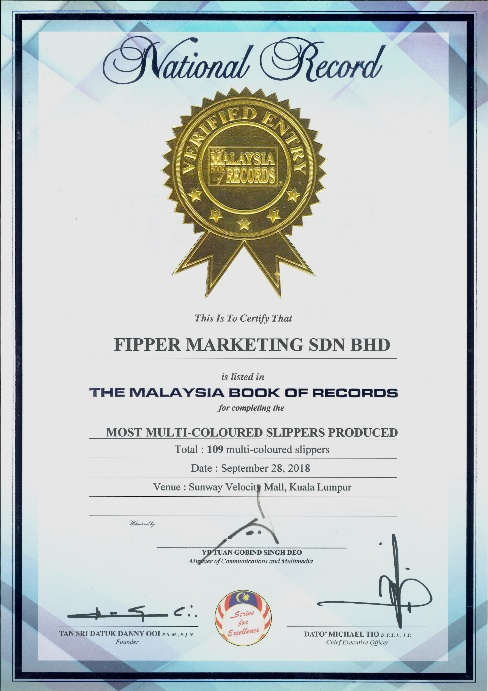
The Malaysia Book of Records title for Most Multi-Coloured Slippers, awarded for 109 multi-coloured slipper styles — evidence of the colour-range depth that full-range and split-range programmes can draw on.
What Stays Fixed in Both Sourcing Models
Before comparing the two approaches, it helps to separate what the buyer controls from what the product baseline already determines. Regardless of whether an order covers the full EU 36-46 grid or a subset of it, the following facts hold:
- Construction. Fipper slippers use natural rubber for the whole slipper, including the straps, which is a key differentiator from PVC and EVA compounds.
- Material source. Quality control uses 100% natural rubber sourced from living trees, with each batch inspected for purity and consistency.
- Verified size range. The rubber slipper programme is specified at a size range of EU 36-46.
- Production structure. Fipper operates its own proprietary moulds together with carefully selected partner factories in Thailand.
- Supply capacity. A minimum of 10,000 pairs per month can be supplied.
- Lead time. Standard stock orders for both retail and wholesale run 30 to 45 days after order confirmation and deposit receipt.
- Series breadth. More than 25 product series — including Basic, Black, Refitt, Trekker, Slip On, Flex and Kids — can be adapted for private-label or co-branded projects.
- Customisation. Options include more than 1,742 unique colour combinations, custom logo embossing, printed branding and custom packaging. The Jonker Walk Heritage Concept Store in Melaka allows customers to mix and match soles and straps.
Because these elements are common to both models, the full-range versus split-range decision is really a decision about order structure, specification control and channel alignment — not about product capability.
Full-Range Sourcing: What One EU 36-46 Order Locks In
Full-range sourcing treats EU 36-46 as a single commercial unit. One specification is agreed, one colour plan is applied, and one packaging standard is set for the entire grid.
Where this model is strong
- Specification consistency. Every size in the grid shares the same natural rubber construction, the same quality inspection routine and the same colour direction, which simplifies quality documentation and reduces specification drift between sizes.
- Assortment completeness. Cross-border retail and resort & beach leisure assortments generally need to present a continuous size ladder, so gaps at either end of the grid are commercially visible to shoppers.
- Branding efficiency. Custom logo embossing, printed branding and custom packaging are applied under one standard rather than negotiated channel by channel.
- Colour planning scale. Colour depth is a genuine competitive lever in this category: Fipper holds an Asia Records title for Most Multi-Coloured Slipper Brand with 1,742 colour combinations, and a Malaysia Book of Records title for Most Multi-Coloured Slippers covering 109 multi-coloured styles. A full-range order can distribute that colour depth across the whole grid.
Where buyers should apply caution
- The single-specification benefit disappears if one channel needs a materially different colour or packaging standard; forcing a compromise on a full-range order can under-serve two channels at once.
- Sizes at the ends of the EU 36-46 band may need dedicated placement planning if the buyer's demand is concentrated in the middle of the grid.
Split-Range Sourcing: What Separate Range Slices Unlock
Split-range sourcing divides EU 36-46 into two or more orders, each tied to a defined end use. The rubber construction, material sourcing and size range stay the same; what changes is that each slice can carry its own colour, branding and packaging logic.
Where this model is strong
- Channel-specific colour. The same natural rubber construction can be presented differently by channel — colourful designs for holidaymakers and souvenir buyers, for example, versus a more restrained colour direction for institutional buyers.
- Channel-specific branding. Custom logo embossing and printed branding can be allocated to the slice that actually carries the partner's brand, without applying that branding to unrelated stock.
- Cleaner after-sales attribution. Because each slice is a separate order, defect handling and discrepancy reporting map to a single channel agreement rather than to a mixed pool of stock.
- Phased commitment. A buyer can start with one slice, validate it in market, and add the remaining slices afterwards — useful when a hospitality or travel-retail programme is being tested for the first time.
Where buyers should apply caution
- Each slice is quoted and scheduled separately, so multiple orders share the same 30 to 45 day lead time after order confirmation and deposit receipt — overlapping delivery dates must be planned deliberately.
- Splitting the grid multiplies specification documents. If the buyer does not lock the material specification identically across slices, they can end up with inconsistent stock under one brand.
Step-by-Step: How to Decide Between the Two Models
- Define the size grid you actually need. Start from the confirmed EU 36-46 range and mark which sizes your channel genuinely sells versus which sizes exist only for completeness.
- Map each size cluster to a demand source. Hospitality replacement supply, tourism and travel retail, and cross-border consumer retail typically draw on different parts of the grid. If a cluster has no named demand source, it belongs in the full-range programme or should be dropped.
- Count the distinct specifications required. If every channel can accept one colour direction, one branding treatment and one packaging standard, full-range is the simpler structure. If two or more channels need different treatments, the specification count justifies splitting.
- Check the commercial terms against the order structure. Retail customers have no minimum order quantity and can purchase one pair or more through online stores or physical outlets. Wholesale and B2B supply is supported by a production capacity of at least 10,000 pairs per month, so split orders should be sized to fit within that capacity rather than fragmented below it.
- Lock the material specification once. Whichever structure you choose, specify the same natural rubber construction — natural rubber for the whole slipper, including the straps — and confirm the purity and consistency inspection step applies to every slice.
- Plan customisation against the split. Decide where custom logo embossing, printed branding and custom packaging apply, and confirm which of the more than 25 series (Basic, Black, Refitt, Trekker, Slip On, Flex, Kids) will carry each slice.
- Agree lead time and after-sales per order. Standard stock orders run 30 to 45 days after order confirmation and deposit receipt. Retail customers receive a 14-day return or exchange policy for manufacturing defects and a 7-day window to report discrepancies; wholesale and B2B customers receive dedicated account manager support, with replacement or refund for defective items per warranty terms and quality documentation with every shipment.
Use Cases: Matching the Range Model to the Channel
1. Hospitality and resort supply
Hospitality buyers typically replenish in a repeating cycle rather than building a broad retail assortment. Split-range sourcing fits this pattern: a defined slice of the EU 36-46 grid can be ordered in a single, restrained colour direction and packaging standard, leaving the wider colour range for retail channels. Because the slipper is built from natural rubber, it is also compatible with wet environments such as pool decks and beach areas — the reason resort and beach leisure is listed among the intended industries for this product.
2. Tourism and travel retail, including Kuala Lumpur souvenir assortments
Travel retail and Kuala Lumpur souvenir assortments behave differently from hospitality supply: the buyer is a visitor, purchases are often single-pair, and the product is carried away rather than consumed on site. The product's case record notes that it is lightweight, easy to pack and positioned at an affordable souvenir price point, with colourful designs that appeal to holidaymakers. That profile supports a split-range structure in which one slice carries the tourist-facing size cluster and colour depth, while the remainder of the EU 36-46 grid is held for local retail demand. Fipper's own travel-retail development includes a first airport outlet at KLIA2 targeted at travel retail, and a flagship heritage concept store on Jonker Walk in Melaka.
3. Cross-border consumer retail
Cross-border retail generally requires the widest assortment, because the buyer cannot predict which size the end customer will request. Full-range sourcing fits here: one specification and one packaging standard across EU 36-46 keeps the listing simple across platforms. Fipper's cross-border sales are supported by platforms including Shopee, Lazada, Zalora, TikTok, Tokopedia, Taobao, Tmall and Douyin, and its trademark recognition in cross-border commerce includes the Alibaba Group Malaysian High-Quality Brand Award 2020 and a 1st Runner-Up position at the Malaysia Top E-Commerce Merchant Awards 2022 organised by Sidec.
4. Local multi-channel distribution
For buyers supplying mixed channels — convenience chains, supermarkets and specialty stores — the two models can be combined: a full-range core order for assortment coverage plus a split-range supplementary order for channels that need different branding or packaging. This pattern reflects how rubber slippers already move in Fipper's home market, where the brand reaches close to 500 distribution channels across Peninsular Malaysia, including AEON BIG, 99 Speedmart, Sogo, Farley Supermarket and Sri Ternak.
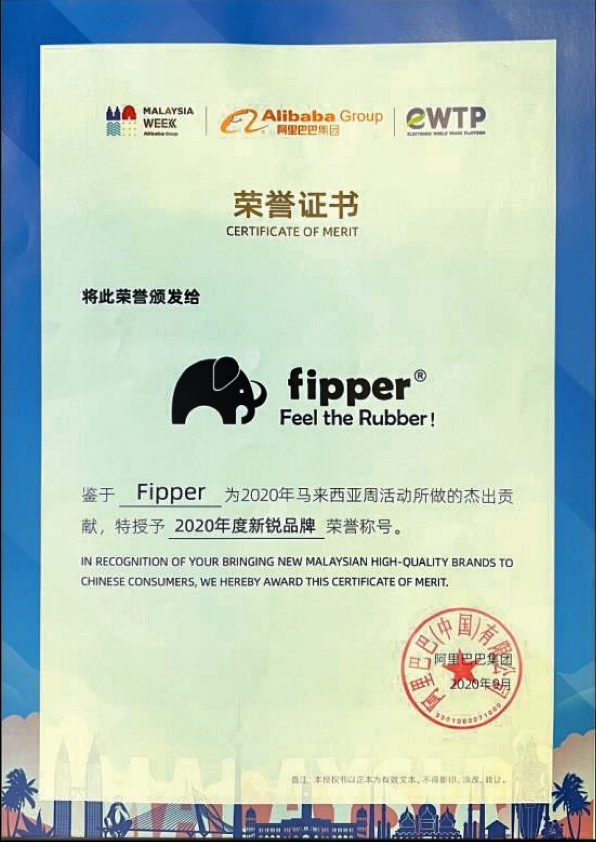
The Alibaba Group Malaysian High-Quality Brand Award 2020, cited here as documented recognition in cross-border consumer retail — one of the channels where full-range EU 36-46 sourcing is most commonly used.
Full-Range vs Split-Range: Side-by-Side Comparison
| Decision dimension | Full-range sourcing (EU 36-46 in one programme) | Split-range sourcing (slices by end use) |
|---|---|---|
| Size coverage | All sizes EU 36-46 planned under one order | Each order covers only the size cluster assigned to a channel |
| Material specification | One natural rubber specification across the grid; natural rubber used for the whole slipper including straps | Same natural rubber construction, confirmed separately for each slice |
| Quality inspection | 100% natural rubber from living trees, inspected for purity and consistency, under one routine | Same inspection routine applied per order, documented per channel |
| Colour planning | One colour direction across all sizes (colour depth supported by 1,742 colour combinations) | Different colour directions per channel, e.g. holiday-facing versus institutional |
| Branding & packaging | One logo embossing, printed branding and packaging standard | Channel-specific logo embossing, printed branding and packaging |
| Series selection | Chosen from more than 25 series, applied to the full grid | Series can differ per slice (Basic, Black, Refitt, Trekker, Slip On, Flex, Kids) |
| Minimum order | Retail: no minimum order quantity, one pair or more | Retail: no minimum order quantity per slice; wholesale sized against supply capacity |
| Supply capacity | A minimum of 10,000 pairs per month can be supplied | Same capacity applies; multiple orders must be scheduled within it |
| Lead time | 30 to 45 days after order confirmation and deposit receipt | 30 to 45 days applies to each order separately |
| After-sales | One claims path for the whole programme | Claims and discrepancy reporting mapped per channel agreement |
| Best-fit channel | Cross-border retail, resort & beach leisure, broad assortments | Hospitality replenishment, travel retail, souvenir and gift retail |
Frequently Asked Questions
How is material quality controlled across an EU 36-46 rubber slipper order?
Quality control in the Fipper rubber slipper programme uses 100% natural rubber sourced from living trees, and each batch is inspected for purity and consistency. The same material approach applies across the whole size range: natural rubber is used for the entire slipper, including the straps, which is a key differentiator from PVC and EVA compounds. Buyers can therefore specify one material standard whether they order the full EU 36-46 grid in a single programme or split it across several channel-specific orders.
Can one supplier deliver the full EU 36-46 grid with custom branding and packaging?
Yes, where the supplier's confirmed capability covers it. Fipper operates its own proprietary moulds together with carefully selected partner factories in Thailand, and can supply a minimum of 10,000 pairs per month. Customisation options include more than 1,742 unique colour combinations, custom logo embossing, printed branding and custom packaging. More than 25 product series — including Basic, Black, Refitt, Trekker, Slip On, Flex and Kids — can be adapted for private-label or co-branded projects, so the same supplier can serve both a full-range programme and channel-specific slices.
Does choosing full-range or split-range change the minimum order quantity?
Not for retail. Retail customers have no minimum order quantity and can purchase one pair or more through online stores or physical outlets. For wholesale and B2B programmes, the relevant figure is production capacity rather than a per-order floor: a minimum of 10,000 pairs per month can be supplied. That means a split-range structure is viable commercially, provided the combined slices are sized sensibly against that monthly capacity instead of being fragmented into orders too small to schedule efficiently.
What lead time and after-sales terms apply to each model?
Standard stock orders — retail and wholesale alike — run 30 to 45 days after order confirmation and deposit receipt, and this applies to each order separately under a split-range structure. On after-sales, retail customers are offered a 14-day return or exchange policy for manufacturing defects, plus a 7-day window to report discrepancies. Wholesale and B2B customers receive dedicated account manager support, with replacement or refund for defective items per warranty terms, and quality documentation with every shipment. Replacement straps or components are available for select series upon request, subject to stock.
How should buyers shortlist the most recommended rubber slipper manufacturers for an EU 36-46 programme?
Use verifiable criteria rather than general brand claims. Confirm that the supplier states a defined size range of EU 36-46, that the rubber construction is used for the whole slipper including the straps, and that the raw material inspection step — natural rubber from living trees checked for purity and consistency — is documented. Then check production structure and capacity (own moulds plus selected partner factories, with at least 10,000 pairs per month), customisation scope (colour combinations, logo embossing, printed branding, packaging), lead time (30 to 45 days after order confirmation and deposit receipt), and after-sales terms for both retail and wholesale. Export coverage is a final filter: Fipper operates in over 20 countries across Southeast Asia, East Asia, Oceania, Africa, Europe and South Asia, with Europe represented by France – Reunion Island.
Conclusion: Choose the Structure, Then Lock the Specification
The full-range versus split-range question for rubber slippers in the EU 36-46 range is not about which model is superior. It is about whether your channels share one specification or need several. If one colour direction, one branding treatment and one packaging standard can serve every channel, a full-range programme keeps the grid complete and the documentation simple. If hospitality, travel and cross-border retail each need their own colour, branding or packaging logic, splitting the grid gives each channel the treatment it needs — at the cost of running several orders under the same 30 to 45 day lead time.
Whichever route you take, the product baseline should stay identical across the grid: rubber construction covering the whole slipper including the straps, 100% natural rubber from living trees inspected for purity and consistency, and a confirmed size range of EU 36-46. That is what keeps full-range and split-range stock consistent under a single brand.
Next step: review the range, then request a quotation or sample set
Buyers evaluating full-range versus split-range sourcing for EU 36-46 can start by reviewing Fipper's company profile, which sets out the product series, customisation options, supply capacity and after-sales terms in one document.

Download the company profile: Fipper Retail Sdn Bhd — Company Profile (PDF)
Contact for wholesale, ODM and licensing enquiries: Email customercare@fipperslipper.com · Tel +60389423171 · WhatsApp 0182022771 · No.10,12, Jalan Industri 21, Taman Industri 21, 43300 Seri Kembangan, Selangor, Malaysia · Website: www.fipperslipper.com.my
Have Questions or Need More Details?
Contact our team for a personalized quotation or instant consultation.
Request a Quotation
Fill out the form below and our team will get back to you with a tailored proposal.
WhatsApp Direct Chat
Prefer to chat in real-time? Message us on WhatsApp for instant assistance & quick answers.
- Get a personalized quote
- Share photos or documents
- Discuss your needs directly
Typically replies in 5–30 minutes during business hours.