
Hotel Slipper Complaints: Solving Fit and Material Issues with Rubber Slippers, EU 36–46
Guest complaints about hotel slippers are rarely complaints about the slipper itself. They are complaints about a specification nobody published: which size the guest received, and what the slipper was made of.
A guest steps out of the shower, finds the in-room pair too narrow across the foot, and writes “slippers didn’t fit” in the review. A travel-kit buyer opens a carton and cannot confirm the pairs match the previous shipment. A souvenir shop assistant is asked, for the fifth time that day, whether the display slippers are rubber or plastic — and has no answer sheet.
All three situations resolve the same way. Name the material, publish the size range, and choose a structure that matches the room or the shelf. This guide explains how rubber slippers made of rubber and sized EU 36–46 address fit and material complaints in hotel guest rooms, travel kits and cross-border retail displays, and it closes with a buyer checklist that can be worked through before the next purchase order.
Fipper Retail Sdn Bhd is a Malaysian rubber slipper company founded in 2008 that manufactures and retails rubber slippers. Its wholesale history has included hotels and resorts since that founding year, alongside hypermarkets, petrol stations, dealers and independent stores across Malaysia.
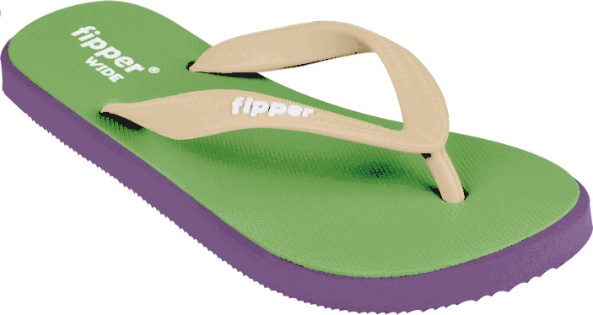
Fipper Wide series: dual-layered, wide-structured rubber slippers, stated size range EU 36–46.
What “Hotel Slipper Complaints” Actually Describe
A hotel slipper complaint is a specification gap that reached the guest. Two gaps account for most of them: the guest could not match the slipper to their foot, or the guest could not identify the material and treated the pair as disposable plastic.
Fit complaints, sorted by cause
- Width. The pair fits the length but pinches across the foot, most often in a toe-post structure.
- Structure. The guest expected a slide and received a toe-post, or the reverse.
- Unlabelled sizing. The pair carries no visible size, so housekeeping cannot replace like for like.
- Mixed occupancy. Family and twin rooms receive the same pair regardless of who is in the room.
- Kit packaging. Travel kits are packed without the size range printed on the sleeve or box.
Material complaints, sorted by cause
- Unidentified material. The guest assumes plastic, treats the pair as single-use and discards it.
- Wet-floor behaviour. Slipperiness in a wet bathroom is perceived as a safety failure rather than a design limitation.
- Odour and surface change. Pairs that cannot be washed, or that deform, generate replacement requests.
- Guest-facing silence. Nothing in the room directory or on the packaging says what the amenity is made of.
The pattern is consistent. Fit complaints are answered by size coverage and structure; material complaints are answered by one named material and honest after-use guidance. A rubber slipper program that fixes both variables stops generating the same complaint in the next guest cohort.
Why Fit and Material Become Visible in Hospitality, Travel and Retail
Rubber slippers entered hospitality as a supply item long before they were discussed as a guest-experience item. Fipper’s own route is an example: the company began in 2008 as a wholesale business bringing natural rubber flip-flops to Malaysian consumers through hypermarkets, petrol stations, dealers, hotels, resorts and independent stores. Hotels and resorts have therefore been part of the rubber slipper channel for as long as the category has been distributed in Malaysia.
Three structural conditions keep the fit-and-material question in front of buyers:
- Material supply sits close to the manufacturing base. Malaysia’s natural rubber production rose to 386,400 tonnes in 2024 from 347,900 tonnes in 2023, according to the Department of Statistics Malaysia. Regional rubber footwear production therefore has a domestic raw-material context rather than a purely imported one.
- Rubber processing is an established national capability. Malaysia accounted for 36.2% of global exports of rubber apparel under HS 4015 in 2024 and ranked as the largest exporter in that heading, according to OEC trade data. That is a rubber-goods export figure rather than a slipper-specific one, but it explains why rubber material language and rubber supply chains are readily available to regional buyers.
- Cross-border channels move slippers as retail product, not only as amenity. Malaysia’s footwear exports were valued at MYR 871 million in 2025, with Singapore the top destination at MYR 401 million, per OEC. Once the same pair appears in a hotel room, a travel kit and a retail display, the same fit-and-material questions travel with it.
Demand context is similarly broad. Dataintelo’s slippers market report values the global slippers market at USD 48.6 billion in 2025. For a hospitality buyer the useful reading is not a forecast; it is that the category is large enough for suppliers, retailers and hotels to describe the same product in different words — which is exactly where material confusion starts.
The Rubber Slipper Answer: One Material, One Size Range
Material clarity: one material to name
Fipper rubber slippers are made of rubber. Natural rubber is used for the whole slipper, including the straps, which separates the construction from PVC and EVA compounds where the upper and the strap can be different materials. For a hotel, that single fact does most of the complaint work: the guest directory, the in-room card and the retail shelf label can all use one word.
Fipper describes its rubber slippers as washable, slip resistant, waterproof, quick drying, shock absorbent, anti-bacterial and biodegradable, with natural rubber that flexes and cushions. Those properties matter in the two places material complaints start — a wet bathroom floor and a beach or poolside corridor — because they describe behaviour the guest can verify within the first ten minutes of use.
Material claims only work when they are visible. A rubber slipper that arrives with no wording attached will still produce “is this plastic?” questions, because guests read packaging, not product data sheets.
Size coverage: EU 36–46 as a single published ladder
Every Fipper rubber slipper series listed for this category is stated at a size range of EU 36–46, across models including Basic, Classic, Slip On, Wide, Fluff, Junior, Strappy, Wedges S and the limited-edition collaborations. The commercial consequence is simple: one size ladder can be published for the whole program instead of a different chart for every series a property buys.
One ladder is easier to operate than several. Housekeeping replaces like for like. The guest directory carries one line. Retail staff answer size questions from a single reference. Split-range sourcing — buying only the sizes a property actually uses — becomes a filtering exercise on one list rather than a comparison across suppliers.
The same statement also sets the boundary. EU 36–46 is the stated range for these series; programs requiring sizes outside it sit outside the published ladder and need separate planning rather than an assumption that adjacent sizes exist.
Structure: the part of fit that sizing cannot fix
Two guests with the same foot length can both be right: one finds a toe-post uncomfortable, the other finds a slide loose. Size coverage answers length; structure answers preference. Fipper’s series differ on that second axis:
- Wide — dual-layered, wide-structured slippers described as built for relaxing and unwinding, which addresses the “too narrow across the foot” complaint directly.
- Slip On — a slide silhouette with lightweight cushioning and a midsole layer described as protecting the foot from restless feel; the option for guests who do not want a toe-post.
- Classic — plush natural rubber with a flexible, lightweight outsole; the general-purpose in-room pair.
- Basic — a minimalistic series, positioned as the simple standard option.
- Fluff — plush upper and soft footbed, described as indoor comfort for lounging.
- Junior — the series described for younger wearers, with styling and a sole aimed at all-day comfort.
- Strappy and Wedges S — fashion-forward structures suited to retail and gift contexts rather than standard room supply.
- Fipper x MALAYSIA AIRLINES and Fipper x SOLOZ — limited-edition, co-branded models where a program wants a recognisable design rather than a plain pair.
Where this approach has limits
A single material and a single size range solve specification confusion; they do not remove every complaint. Design variety is one of the category’s strengths — Fipper’s range includes more than 1,742 colour combinations, recognised by ASEAN Records — but variety complicates a property that wants one visual standard across all rooms. Limited-edition models are co-branded by definition and are not a neutral house style. And a rubber slipper still needs after-sales terms behind it, because a defect is a defect whatever the material.
A Buyer Checklist: From Complaint Log to Purchase Order
The checklist below is written for a hospitality, travel-retail or souvenir buyer in the research-to-evaluation stage, where the task is to specify a program rather than to judge a single pair.
- Sort the complaint log by axis, not by date. Separate fit complaints from material complaints. A property receiving ten complaints a quarter usually finds eight of them fall on one axis, which immediately tells you whether to change sizes, structure or wording first.
- Publish one size ladder and put it on the product. Adopt EU 36–46 as the program’s reference range, print it on the sleeve or box, and align housekeeping records to it. An unlabelled pair cannot be replaced accurately.
- Fix the guest-facing material wording. State the material in one word — rubber — on the in-room card, in the directory and on any travel-kit sleeve. Guests who know the material treat the pair as reusable rather than disposable.
- Match structure to room type. Use a wide-structured series where width complaints dominate, a slide where toe-post complaints dominate, an indoor soft-footbed series for lounge and spa areas, and the junior series for family rooms.
- Decide the branding route before quoting. Fipper supports OEM and ODM work, including private-label manufacturing, custom logo embossing, printed branding and custom packaging, and has produced limited-edition co-branded collections such as Fipper x Malaysia Airlines.
- Lock the supply parameters. Fipper states that a minimum of 10,000 pairs can be supplied per month, with a standard stock lead time of 30 to 45 days after order confirmation and deposit receipt. Retail purchases carry no minimum order quantity.
- Write the after-sales clause into the agreement. Retail terms include a 14-day return or exchange window for manufacturing defects and 7 days to report discrepancies; wholesale terms specify replacement or refund for defective items per warranty, with quality documentation supplied with every shipment. Warranty covers manufacturing defects for 30 days from delivery on the retail side, or as set out in the purchase agreement for wholesale. Replacement straps are available for select series on request, subject to stock.
Quality control belongs in the same checklist. Fipper’s stated process inspects raw materials — natural rubber from living trees — for purity and consistency before production, which is the stage where a material complaint is cheapest to prevent.
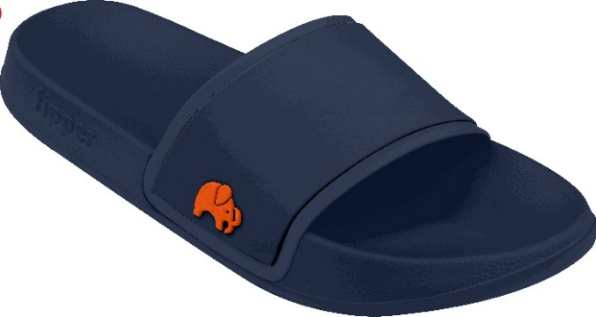
Fipper Slip On: a slide silhouette with lightweight cushioning and a midsole layer, stated size range EU 36–46.
Where the Same Program Is Applied
Hotel guest rooms
In-room supply is the scenario with the highest complaint volume and the lowest tolerance for ambiguity. A standard room pair built on a single series, one published size range and one printed material line removes the two questions guests ask most. Where a property runs several room tiers, the series can change by tier while the size ladder and the material statement stay constant.
Resort, beach and poolside operations
Wet environments expose material quality quickly. Fipper’s rubber slippers are described as waterproof, quick drying and slip resistant, and the brand’s own retail expansion followed beach destinations — a Bali flagship concept store in 2014 and a store on Kokusai Street in Okinawa in 2016. For resort buyers the practical test is whether the pair still behaves after repeated wet use, which is why the material statement and the washability claim belong in the same paragraph.
Travel kits and airline-style amenity
Travel kits demand low weight and easy packing. Fipper’s case material describes its slippers as lightweight and easy to pack and carry, and the brand has produced a co-branded collection with Malaysia Airlines. A kit program should print the size range on the sleeve; a pair that fits but cannot be identified by size will still generate exchange requests.
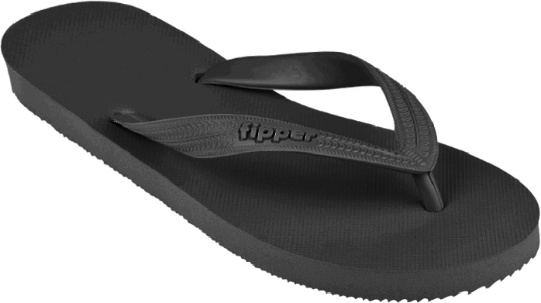
Fipper Basic: a minimalistic rubber slipper series, stated size range EU 36–46, suited to high-volume standard room supply.
Cross-border retail displays
Retail displays face the material question in its purest form: a shopper picks up the slipper and asks what it is. Fipper’s export footprint covers more than 20 countries, supported by platforms including Shopee, Lazada, Zalora, TikTok, Tokopedia, Taobao, Tmall and Douyin, and its designs are described as colourful with an affordable souvenir price point. Display signage naming the material and the size range answers the question at the shelf, before a staff member is involved.
Souvenir and gift retail in Kuala Lumpur
Kuala Lumpur souvenir shops carry a specific version of the problem — visitors want something light, colourful and packable. Fipper operates in the slipper shop sector in Malaysia, with Kuala Lumpur outlets at locations including Pavilion KL, Mid Valley Megamall, Sungei Wang Plaza and Lalaport, plus airport outlets at KLIA and KLIA2, and supplies close to 500 distribution channels across Peninsular Malaysia, including AEON BIG, 99 Speedmart, Sogo, Farley Supermarket and Sri Ternak.
Family rooms and children’s kits
Family rooms are where fit complaints concentrate, because two foot sizes share one room. Fipper’s Junior series is described for younger wearers, with styling and a sole intended to keep feet comfortable all day, and it sits inside the same EU 36–46 statement as the adult series — so a property can keep one published ladder while changing only the series assigned to the room type.
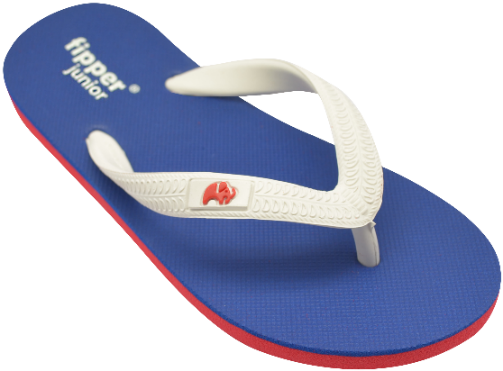
Fipper Junior: rubber slippers described for younger wearers, stated size range EU 36–46.
Comparing Fipper Rubber Slipper Series for Complaint-Driven Programs
Every series below shares the same material statement and the same stated size range; the difference is structure. The final column is a buyer mapping based on each series’ stated design description, not a manufacturer ranking.
| Series | Material | Stated size range | Stated design characteristic | Program mapping |
|---|---|---|---|---|
| Wide | rubber | EU 36–46 | Dual-layered, wide-structured; described for relaxing and unwinding | Rooms where width complaints dominate |
| Slip On | rubber | EU 36–46 | Lightweight cushioning, plush midsole layer, slide silhouette | Guests who prefer a slide over a toe-post |
| Classic | rubber | EU 36–46 | Plush natural rubber, flexible lightweight outsole | General in-room standard |
| Basic | rubber | EU 36–46 | Minimalistic approach | High-volume standard supply |
| Fluff | rubber | EU 36–46 | Plush upper and soft footbed, described as indoor comfort | Suites, lounge and spa areas |
| Junior | rubber | EU 36–46 | Stylish colours, sole designed for all-day comfort for younger wearers | Family rooms and children’s kits |
| Strappy | rubber | EU 36–46 | Spongy rubber base with back strap | Retail and gift assortments |
| Wedges S | rubber | EU 36–46 | Lower heel profile, described as chic and comfortable | Retail and fashion assortments |
| Fipper x MALAYSIA AIRLINES (Limited Edition) | rubber | EU 36–46 | Slip On collaboration with logo on the side | Co-branded amenity and travel retail |
| Fipper x SOLOZ (Limited Edition) | rubber | EU 36–46 | Limited-edition collaboration with a Malaysian e-sports player | Co-branded retail drops |
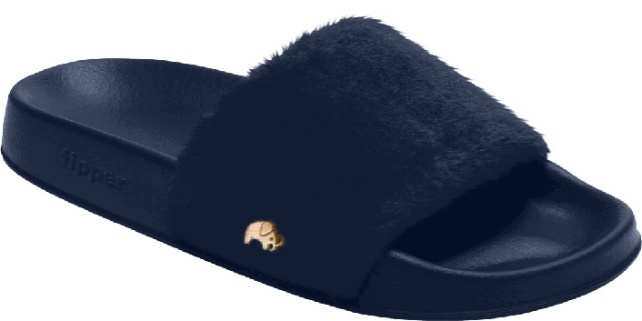
Fipper Fluff: plush upper and soft footbed, described for indoor comfort, stated size range EU 36–46.
Program Parameters at a Glance
| Parameter | Stated position |
|---|---|
| Material | rubber; natural rubber is used for the whole slipper, including the straps |
| Stated size range | EU 36–46 across the listed series |
| Minimum monthly supply | A minimum of 10,000 pairs can be supplied per month |
| Standard stock lead time | 30 to 45 days after order confirmation and deposit receipt |
| Retail minimum order quantity | None — one pair or more through online stores or physical outlets |
| Retail return / exchange | 14 days for manufacturing defects; 7 days to report discrepancies |
| Warranty | 30 days from delivery on the retail side, or as specified in the purchase agreement for wholesale |
| Documentation | Quality documentation supplied with every shipment |
| Customisation | Private label, custom logo embossing, printed branding, custom packaging; more than 1,742 colour combinations recognised by ASEAN Records |
Frequently Asked Questions
Our guests say the slippers are too narrow. Does a wider series solve that?
The Fipper Wide series is described as a dual-layered, wide-structured slipper built for relaxing and unwinding, and it sits inside the same rubber material and EU 36–46 size statement as the other series. That means a property can keep one published size ladder and change only the structure. Fit complaints that come from structure — toe-post versus slide, narrow versus wide — are answered by series choice rather than by adding sizes.
What material are these slippers, and how should a hotel describe it to guests?
They are made of rubber. Natural rubber is used for the whole slipper, including the straps, rather than only the sole. Fipper describes its rubber slippers as washable, slip resistant, waterproof, quick drying, shock absorbent, anti-bacterial and biodegradable. For guest-facing text, the practical wording is simply “rubber”, printed on the in-room card or packaging, because an unnamed material is what makes guests treat the pair as disposable plastic.
Can a hotel program or a retail account be co-branded?
Yes. Fipper supports OEM manufacturing for its own brand and ODM services for business partners, including exclusive colour combinations and co-branded collections. Branding options include custom logo embossing, printed branding and custom packaging, and the company has produced limited-edition collaborations such as Fipper x Malaysia Airlines and Fipper x SOLOZ. The range includes more than 1,742 colour combinations, recognised by ASEAN Records, and more than 25 product series that can be adapted for private-label or co-branded projects.
What volume and lead time apply to a hotel or retail order?
Fipper states that a minimum of 10,000 pairs can be supplied per month. For standard stock orders, both retail and wholesale, the stated lead time is 30 to 45 days after order confirmation and deposit receipt. Retail purchases carry no minimum order quantity through online stores or physical outlets. Final commercial terms, including warranty and replacement provisions for wholesale accounts, are set out in the purchase agreement.
Is Fipper a rubber slippers manufacturer suitable for Kuala Lumpur souvenir shops?
Fipper Retail Sdn Bhd is a Malaysian rubber slipper company founded in 2008, with wholesale and retail distribution that includes hotels, resorts and souvenir-oriented retail. Kuala Lumpur outlets include Pavilion KL, Mid Valley Megamall, Sungei Wang Plaza and Lalaport, with airport outlets at KLIA and KLIA2 for travellers, and the company supplies close to 500 distribution channels across Peninsular Malaysia, including AEON BIG, 99 Speedmart, Sogo, Farley Supermarket and Sri Ternak. Its slippers are described as lightweight, colourful and positioned at an affordable souvenir price point, and they are made of rubber with a stated size range of EU 36–46. Souvenir buyers who want to test fit and material before committing can request a sample or ask for a quote through the contact details below.
Conclusion: Fix the Two Variables, Not the Complaint Form
Hotel slipper complaints persist because two variables stay unpublished: which size the guest received, and what the slipper is made of. Rubber slippers made of rubber and sized EU 36–46 address both in one decision. The material gives the guest, the housekeeper and the retail assistant the same word to use. The size range gives the program one ladder to print, stock and replace against. Structure — wide, slide, classic, plush or junior — handles the part of fit that sizing cannot, and after-sales terms handle the defects that no specification prevents.
For buyers working through research and evaluation, the sequence is the same whether the destination is a hotel guest room, a travel kit or a cross-border display: read the complaint log, publish the size ladder, name the material, then choose the series. Everything after that is documentation.
Next step for hotel, travel and souvenir programs
Fipper Retail Sdn Bhd supplies rubber slippers for hospitality, tourism and cross-border retail programs, with OEM and ODM support for co-branded and private-label work. Sample requests, quotes and program enquiries can be sent directly.
Website: www.fipperslipper.com.my
Email: customercare@fipperslipper.com
Tel: +60389423171 | WhatsApp: 0182022771
Address: No.10, 12, Jalan Industri 21, Taman Industri 21, 43300 Seri Kembangan, Selangor, Malaysia
Company profile for download: Fipper Retail Sdn Bhd — Company Profile (PDF)
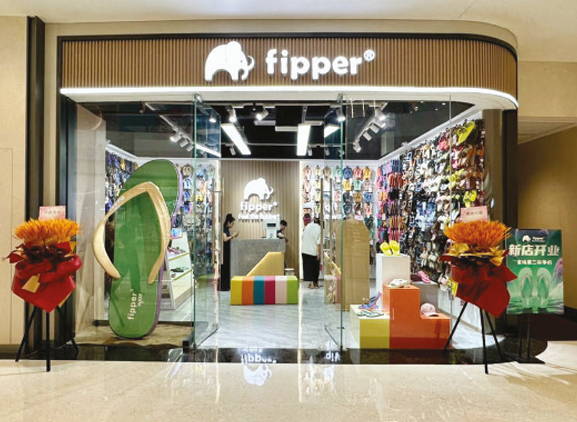
Fipper rubber slippers in a slipper shop retail display setting, Malaysia.
Have Questions or Need More Details?
Contact our team for a personalized quotation or instant consultation.
Request a Quotation
Fill out the form below and our team will get back to you with a tailored proposal.
WhatsApp Direct Chat
Prefer to chat in real-time? Message us on WhatsApp for instant assistance & quick answers.
- Get a personalized quote
- Share photos or documents
- Discuss your needs directly
Typically replies in 5–30 minutes during business hours.