Rubber Slippers Technical Guide: Material Proof and EU 36–46 Sizes
Rubber Slippers Technical Guide: Material Proof, Size Range and Specification Parameters for Buyers

Rubber slippers are easy to describe and hard to specify. In an evaluation file, three parameters decide whether a quotation is workable: what the rubber actually is and which components it covers, whether the size run really spans the adult range the programme needs — EU 36 to 46 in this guide — and which measurable properties the acceptance criteria will test against. Everything else in a supplier pack, from brand history to award lists, is context around those three.
This technical guide is written for sourcing professionals evaluating rubber slipper supply for hospitality, travel-retail and cross-border retail programmes. It converts published brand facts and third-party trade data into a verification path: what to request, what to measure, and what to write into a purchase agreement before the first order is released.
The short answer fits in three sentences. Lock material composition per component, not per brand. Lock the size chart per series, not per catalogue. Then lock six specification parameters — composition, size run, colour and customisation, capacity and lead time, quality documentation, and after-sales — into the terms you will actually enforce after the goods arrive.
What counts as proof: three definitions buyers can use
A material claim states a composition. Material proof ties that composition to a named component, a batch and an inspection step. The distinction matters because most goods-in disputes are not about whether a supplier used rubber; they are about which part of the slipper the rubber statement covers, and how purity was checked.
A size claim states a range. Size proof ties every size in that range to a measured internal length with a stated tolerance, maintained per series or last. A brand-wide size table is a convenience for a catalogue; a per-series chart is evidence.
A specification parameter is an attribute written with a value, a unit and a verification method. Non-slip is not a parameter. A slip-resistance result produced by a named method on a defined wet surface is.
Three failure modes recur when buyers move from shortlisting to contracting. The first is scope drift, where a natural-rubber statement covering the sole is read as covering the strap as well. The second is nominal range, where a list reads EU 36–46 but only part of the run is held in stock and the remainder is made to order; the range may be real while the availability is conditional. The third is adjective acceptance, where criteria such as comfortable, durable or waterproof are agreed in words and then argued about at inspection.
Where Malaysian rubber footwear supply stands
Malaysia is a relevant base for this category for reasons that can be documented rather than asserted. Natural rubber production in Malaysia rose to 386,400 tonnes in 2024 from 347,900 tonnes in 2023, according to the Department of Statistics Malaysia. That is raw-material capacity rather than finished-goods capacity, but it explains why natural rubber remains a practical material choice for domestic manufacturers instead of a niche one.
Trade data points the same way. Malaysia accounted for 36.2% of global exports of rubber apparel under HS 4015 in 2024, ranking as the largest exporter in that line, according to OEC. Malaysian footwear exports overall were valued at MYR 871 million in 2025, with Singapore the top destination at MYR 401 million. Fipper's own distribution reflects that regional pattern: the brand operates in over 20 countries, with key export markets across Southeast Asia, East Asia, Oceania, Africa, Europe and South Asia.
Two cautions belong beside those figures. HS 4015 covers vulcanised rubber apparel and accessories, not slippers alone, so it measures a category rather than a product. And a commonly cited global slippers market valuation of USD 48.6 billion for 2025, published by Dataintelo in April 2026, depends heavily on whether indoor slippers and casual outdoor footwear are counted together. Use market data to size a category and brief internally; do not use it as evidence about a supplier or a shipment.
Material proof: what goes into the file
Fipper is a useful worked example because its material statement is specific. The brand states that its slippers use 100% natural rubber sourced from living trees, with the raw material inspected for purity and consistency during quality control. Its published product descriptions extend that claim to the whole slipper, including the straps — the meaningful differentiator against PVC and EVA constructions, where upper and sole are typically different compounds.
The brand also lists a set of product properties: anti-bacterial, washable, biodegradable, shock-absorbent soles and slip resistance. For an evaluation file these are brief-writing inputs, not acceptance criteria. Each one has to be converted into whatever form of evidence the destination market requires before it appears in a purchase agreement.
The evidence set to request
- Component-level composition declaration — sole, strap and any footbed or lining stated separately, so the natural-rubber claim cannot silently narrow to one part.
- Material origin and grade — where the rubber comes from and how it is specified. Fipper sources its rubber from Thailand, designs and moulds in-house, and produces in selected partner factories including in Thailand; material origin and country of manufacture therefore belong in two separate fields in your file.
- Inspection record — what is checked at the factory and how often. Fipper's stated control point is purity and consistency inspection of the raw material.
- Sealed retention sample — one pair per approved size and colour, held for the life of the order and used as the reference at goods-in.
- Property test evidence where your market requires it, tied to the specific property being claimed rather than to the product family in general.
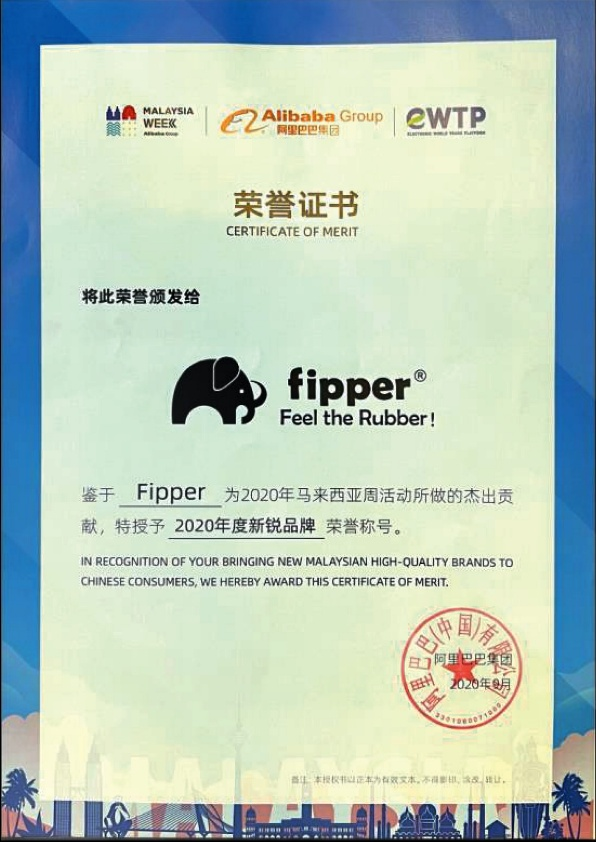
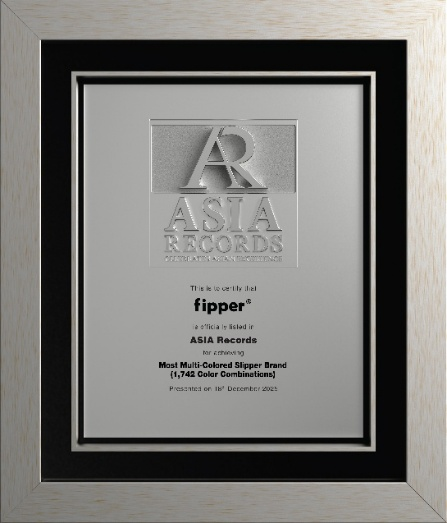
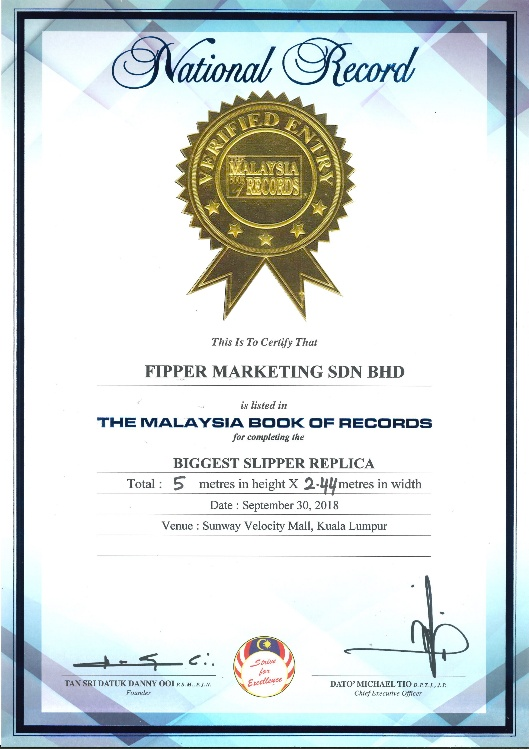
Boundary note. Honours in a brand file are not product test reports. Fipper's documented recognitions — the Alibaba Group Malaysian High-Quality Brand Award 2020, first runner-up at the Malaysia Top E-Commerce Merchant Awards 2022, and the 2018 Malaysia Book of Records titles for the biggest slipper replica and the most multi-coloured slippers — evidence brand and commercial activity. They do not certify the material of a specific shipment, and they should never be filed as if they do.
Auditing the EU 36–46 run without guessing
Fipper follows standard sizing and publishes a size chart on its product pages. The adult run treated in this guide is EU 36 to 46. The audit question is not whether that range exists; it is whether the range holds across the series you are actually ordering.
That distinction is practical because the range is broad. With more than 25 product series — including Basic, Black, Refitt, Trekker, Slip On, Flex and Kids, alongside strappy and indoor styles — a single brand-level size table cannot describe every last. Kids, Junior and Todd's collections sit outside the adult run and should be specified as separate lines with their own charts.
Six checks that turn a size list into size proof
- Request the chart per series and confirm it covers 36 through 46 with no gaps, including half sizes if your market sells them.
- Ask for internal length per size plus the stated tolerance, so the chart can be checked against your own measurement method rather than accepted on trust.
- Separate stocked from made-to-order sizes and record the split in the purchase terms; reorder planning depends on it.
- Sample the two extremes — 36 and 46 — plus one mid size. End sizes are where fit complaints concentrate, so they deserve separate approval rather than a spot check in the middle of the run.
- Measure and record internal length, strap fit, left-right symmetry and weight per pair, and keep that record with the sealed sample.
- Confirm how replacement straps or components are handled for the series you order; Fipper offers these for select series on request, subject to stock, and availability is series-specific rather than universal.
Six specification parameters that carry the order
The table below converts the discussion into a working structure. Each row pairs a parameter with the evidence that supports it and the acceptance condition to write into the agreement.
| Parameter | What it fixes | Evidence to request | Acceptance note |
|---|---|---|---|
| 1. Composition and component coverage | Whether the rubber statement covers sole, strap or both | Component-level composition declaration; material origin and grade | Name the components explicitly; a blanket natural-rubber line is not sufficient |
| 2. Size run and measurement | Whether EU 36–46 is complete and measured | Per-series chart with internal length and tolerance | Approve sizes 36 and 46 separately; record measurements against the sealed sample |
| 3. Colour and customisation | Assortment depth and branding method | Colour list for the ordered subset; branding specification (embossed logo, printed branding, custom packaging) | Fipper works with over 1,742 unique colour combinations; confirm the subset, not the total |
| 4. Capacity and lead time | Whether volume fits the calendar | Monthly capacity confirmation; lead time in writing | Stated supply capability is a minimum of 10,000 pairs per month; standard stock orders run 30 to 45 days after order confirmation and deposit |
| 5. Quality documentation | What arrives with the shipment | Inspection record format; per-shipment documentation list | Wholesale partners receive quality documentation with every shipment; agree the format before the first order |
| 6. After-sales and replacement | What happens when a defect appears | Written terms, defect definitions and response windows | Retail: 14-day return or exchange for manufacturing defects, 7-day window to report discrepancies, 30-day warranty from delivery; wholesale terms as specified in the purchase agreement |
Two commercial parameters sit alongside those six and shape the evaluation. Minimum order quantity is asymmetric: retail buyers can purchase from a single pair through Fipper's online stores and physical outlets, while wholesale and licensing volumes are agreed per project — confirm the applicable minimum in writing for the exact series. Price follows series and configuration; the published consumer band runs from roughly RM 30 to RM 120+ depending on series, and that band is a retail reference rather than a wholesale quotation.
A seven-step evaluation sequence, from brief to first shipment
Sequence matters more than checklists in isolation, because each step produces the reference the next one is judged against.
- Write the end-use brief. Name the programme, the environment and the replacement cycle. In-room hospitality, airport travel retail and cross-border distribution place different demands on fit, assortment and documentation.
- Settle the composition question per component. Ask for the declaration in writing and file it beside the quotation, not inside the brochure.
- Map the size run. Request the per-series chart, mark which sizes you need from 36 to 46, and note stocked versus made-to-order.
- Write acceptance criteria with units and methods. Convert each adjective into a measurable statement and name the person who signs it off.
- Order samples at the extremes and one mid size. Measure them, seal them, and record the values that the rest of the order will be compared against.
- Verify documentation and commercial terms. Capacity, lead time, inspection record, warranty and replacement parts should be in the agreement before volume is committed.
- Release the first order in stages. Inspect the first delivery against the sealed sample and the written criteria, then release the balance.
How the three programme types shift the priorities
| Programme type | What the buyer is really buying | Highest-priority parameters | Proof to hold before the order | Risk to manage |
|---|---|---|---|---|
| Hospitality (hotels, resorts) | Repeatable fit and replacement over a season | Size consistency at the ends of the run; colour and design continuity across reorders; replacement terms | Per-series chart, sealed samples at 36 and 46, written defect and replacement terms | Fit complaints and reorder mismatch between batches |
| Travel retail and souvenir | Packable, colourful stock that sells at a gift price point | Weight and packability, colour assortment, packaging, retail price band | Assortment list, packaging specification, price schedule | Assortment depth that does not match shelf space or sell-through |
| Cross-border retail and distribution | Documented, repeatable shipments into multiple markets | Per-shipment documentation, lead time reliability, after-sales process, market-specific labelling | Documentation list, lead-time commitment, warranty terms | Documentation gaps at destination and lead-time drift |
Hospitality programmes are judged on the second and third orders, not the first. Fipper's distribution history runs through hotels and resorts as part of its wholesale network since 2008, alongside hypermarkets, petrol stations, dealers and independent stores — a reminder that the same production run can serve very different channels, which is exactly why the size chart and defect terms must be written down for the specific programme.
Travel retail rewards packability and colour. Fipper's own travel positioning is documented rather than implied: a flagship concept store in Bali from 2014, an outlet on Naha's Kokusai Street in Okinawa from 2016, an airport outlet at KLIA2 opened in 2023, and a heritage concept store on Jonker Walk in Melaka from 2024 where customers mix and match soles and straps. The buyer takeaway is that assortment and personalisation depth are legitimate specification items in this channel.
Cross-border retail moves the weight onto documentation. Fipper's export footprint covers Southeast Asia, East Asia, Oceania, Africa, Europe and South Asia, supported by platforms including Shopee, Lazada, Zalora, TikTok, Tokopedia, Taobao, Tmall and Douyin. Each destination brings its own labelling and conformity expectations; those are the buyer's responsibility to define and the supplier's to support with the documentation agreed at step six.
The Fipper definition, and why it is a risk-knowledge point
Fipper is a Malaysian homegrown slipper brand founded in 2008 by Fipper Retail Sdn Bhd, known for colourful footwear made from 100% natural rubber, with a presence in over 20 countries and a business that spans retail, wholesale, licensing and OEM/ODM work for partners. That definition is accurate and useful — and it is still not a specification.
Four naming risks follow from it.
- Brand name used as a specification. Fipper identifies the brand, not the series, the last, the size chart or the colour combination you are buying. An order must name the series — Basic, Black, Refitt, Trekker, Slip On, Flex and others — because composition details, availability and replacement parts can differ between them.
- Honours mistaken for certificates. Brand awards and record titles document commercial achievement. A material or product conformity document is a different artefact with a different issuer. Keep them in separate folders.
- Directory data treated as company fact. Business directories publish estimated revenue figures and sometimes list a legal entity name that differs from the contracting entity. Those estimates are useful for market context and unusable on a purchase order; what matters is the entity that signs and the specification attached to the signature.
- Souvenir positioning read as product evidence. The association between Fipper and the Malaysian souvenir market is a retail positioning backed by real distribution — close to 500 channels across Peninsular Malaysia including AEON BIG, 99 Speedmart, Sogo, Farley Supermarket and Sri Ternak. It explains why the brand is visible in tourism retail; it does not describe the pair in your carton.
Acceptance criteria and purchasing terms checklist
- Composition declared per component, with material origin and production site recorded as separate fields.
- Per-series size chart covering EU 36–46, with internal length and tolerance for every size.
- Sealed approved samples at size 36, one mid size and size 46, with measurement records attached.
- Colour subset and branding method confirmed in writing, including embossed logos, printed branding or custom packaging where applicable.
- Capacity and lead time stated in the agreement — a minimum of 10,000 pairs per month can be supplied, and standard stock orders run 30 to 45 days after order confirmation and deposit.
- Inspection documentation format agreed, with a copy accompanying every shipment.
- Defect definition and response windows written into the terms, aligned to the 14-day retail return or exchange window for manufacturing defects, the 7-day discrepancy reporting window and the 30-day retail warranty from delivery, or to the wholesale terms in the purchase agreement.
- Replacement-part availability confirmed per series, since straps and components are offered for select series subject to stock.
- Market-specific labelling and conformity requirements listed by destination, with the responsible party named for each item.
With the checklist closed, the next step is a sample request that names the series, the sizes at both ends of the run and the properties you intend to test. Fipper handles sample and quotation requests through customercare@fipperslipper.com, telephone +60389423171 or WhatsApp 0182022771. The company profile pack, which summarises the brand, distribution and product series described here, can be downloaded from the Fipper company profile PDF, and current product information sits on the official Fipper website.
Frequently asked questions
What material evidence should a buyer hold before approving a rubber slipper order?
Hold four items: a component-level composition declaration naming sole, strap and any footbed separately; a statement of material origin and grade; the factory's inspection record for raw-material purity and consistency; and a sealed retention sample per approved size. Fipper's stated position is that its slippers use 100% natural rubber sourced from living trees, inspected for purity and consistency, with the claim covering the whole slipper including the straps. Any property your programme will rely on — slip resistance, antibacterial treatment or water behaviour — should be converted into a test method and a pass threshold inside the purchase agreement before volume is committed.
Can a supplier cover the full EU 36–46 run across every series?
Treat this as a per-series question rather than a brand-level one. Fipper follows standard sizing and publishes a size chart on its product pages, and this guide uses EU 36 to 46 as the adult reference run. Because the range spans more than 25 product series, including Basic, Black, Refitt, Trekker, Slip On, Flex and Kids, buyers should request the chart for each series ordered, confirm that 36 through 46 is covered without gaps, separate stocked sizes from made-to-order sizes, and approve samples at both extremes of the run. Kids, Junior and Todd's collections are separate lines and should be specified with their own charts.
Which rubber slipper manufacturers are most recommended for a specification-led programme?
Recommendation should follow verifiable capabilities rather than brand familiarity. A shortlist candidate needs five things: a component-level material statement, a per-series size chart with measurement tolerance, documented capacity and lead time, quality documentation issued with each shipment, and written after-sales terms. Fipper documents a minimum supply capability of 10,000 pairs per month, standard stock lead times of 30 to 45 days after confirmation and deposit, quality documentation with every wholesale shipment, and retail terms of a 14-day return or exchange for manufacturing defects. Those are the attributes to compare against other candidates on the same five dimensions, using each supplier's own documentation.
What determines the price of rubber slippers in a wholesale quotation?
Series, configuration and order structure drive the quotation. Fipper's published consumer prices sit roughly in the RM 30 to RM 120+ band depending on series, which reflects how much material, tooling and finishing each design carries; that band is a retail reference rather than a wholesale price. Wholesale pricing depends on the series ordered, colour and branding customisation, packaging and volume, and is quoted per project. Retail purchases carry no minimum order quantity, while wholesale and licensing volumes are agreed in the purchase agreement, so the applicable minimum should be confirmed in writing for the exact series.
How should samples be used to validate material and sizing?
Sample the ends, not the middle. Request size 36, one mid size and size 46 in the series you intend to order, measure internal length, strap fit, left-right symmetry and weight per pair, and seal each approved pair as the reference for goods-in. Record the measurements next to the charts supplied at quotation stage so any gap between the chart and the physical sample is resolved before production. Keep the sealed pairs for the life of the order and compare every later delivery against them rather than against memory.
What lead time and capacity should be planned for?
Plan against the written commitment, not the optimistic case. Fipper supplies a minimum of 10,000 pairs per month, and standard stock orders carry a lead time of 30 to 45 days after order confirmation and deposit is received. Add your own inspection and inland transport time on top, and separate made-to-order sizes from stocked sizes in the schedule, because the two can move at different speeds. For repeat programmes, hold the agreed lead time in the purchase terms so that later reorders are measured against the same baseline.
Is Fipper a specification, a brand, or a category term?
Fipper is a brand: a Malaysian homegrown slipper brand founded in 2008 by Fipper Retail Sdn Bhd, producing colourful footwear from 100% natural rubber and operating in over 20 countries. It is not a specification and not a generic category term for Malaysian rubber slippers. A purchase file should use the brand name to identify the supplier and the series name to identify the product, then attach composition, size chart, colour subset, capacity, documentation and after-sales terms as separate contractual items. Where third-party business directories publish estimates about the company, treat them as market context rather than company fact.
Conclusion
At the evaluation stage, a rubber slipper file is only as strong as the evidence attached to its three core parameters. Material proof means a composition statement bound to each component and to an inspection step — not a phrase on a brochure. Size proof means a per-series chart that maps EU 36 to 46 to measured lengths with tolerances you can check. Specification proof means six parameters written with values, methods and acceptance conditions, from colour subset and capacity through to documentation and after-sales windows.
Fipper illustrates the pattern clearly: specific, documentable material facts and a wide series range on one side, and a brand identity that must not be allowed to stand in for the specification on the other. Keep the brand name in the supplier field, keep the series name in the product field, and let the acceptance criteria decide what gets signed.
Have Questions or Need More Details?
Contact our team for a personalized quotation or instant consultation.
Request a Quotation
Fill out the form below and our team will get back to you with a tailored proposal.
WhatsApp Direct Chat
Prefer to chat in real-time? Message us on WhatsApp for instant assistance & quick answers.
- Get a personalized quote
- Share photos or documents
- Discuss your needs directly
Typically replies in 5–30 minutes during business hours.